

Quarry vs Mine: Key Differences in Operations and Equipment 2026
"Quarry" and "mine" are often used interchangeably, but they refer to different types of extraction operations with distinct purposes, methods, and equipment. Whether you're extracting granite blocks from a surface quarry or blasting iron ore in an open pit mine, the distinction shapes everything from regulatory compliance to drilling equipment selection.
MSD (Zhuzhou Jingde Machinery Co., Ltd.) is a China-based rock drilling tools manufacturer with 23+ years of experience, supplying DTH bits, top hammer button bits, tapered button bits, and DTH hammers for both quarrying and mining operations worldwide. In this guide, we break down the key differences between quarries and mines — and reveal what both operations have in common when it comes to drill and blast.
Key Insight: While quarries and mines extract different materials for different purposes, both rely heavily on drilling and blasting operations. Drilling and blasting typically account for 15–25% of operating costs, but their efficiency determines the productivity of loading and hauling — which represents approximately 50% of total operating costs.
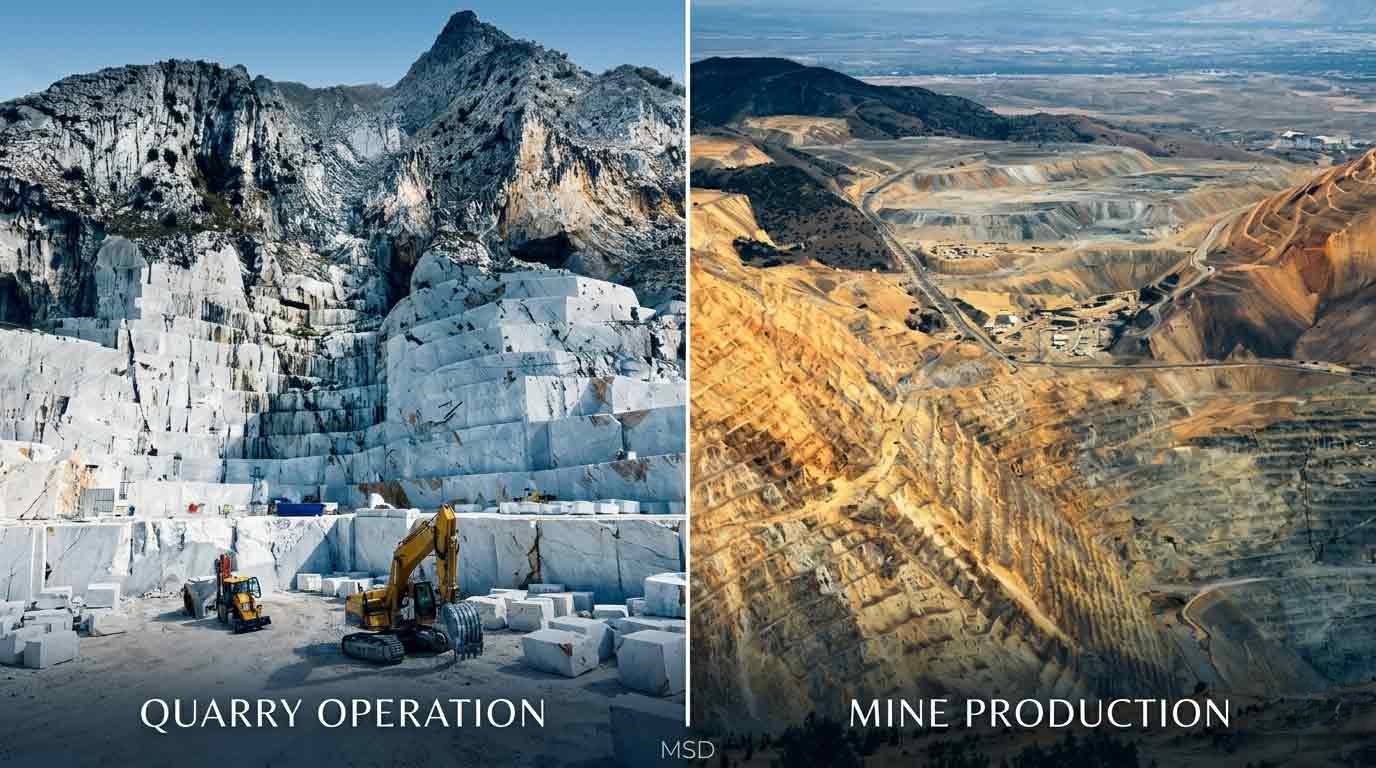
What Is a Quarry? What Is a Mine?
Quarry Definition
A quarry is an open-pit excavation site where stone, rock, sand, gravel, or other construction materials are extracted from the earth's surface. The extracted materials are typically used directly in construction with minimal processing.
Key characteristics: always surface-level (open-air) operations; extracts non-metallic materials; products used directly or with minimal processing; focus on material quality and size.
Common quarry products: limestone, granite, marble, sandstone, gravel, sand, crushed stone aggregate.
Mine Definition
A mine is an excavation site — either surface or underground — where valuable minerals, metals, or coal are extracted for further processing and refinement.
Key characteristics: can be surface (open pit) or underground; extracts metallic ores, coal, or industrial minerals; products require extensive processing; focus on mineral recovery and grade.
Common mine products: gold, copper, iron ore, coal, diamonds, zinc, uranium.
Legal and Regional Definitions
Different countries define these terms differently:
| Region | Quarry Definition | Mine Definition |
|---|---|---|
| UK | Site of mineral extraction without a roof | Underground working |
| USA | Open-pit extraction of construction materials | Any extraction of minerals/metals |
| Australia | Surface extraction of rock/aggregate | Any commercial mineral extraction |
Quarry vs Mine: Complete Comparison
| Factor | Quarry | Mine |
|---|---|---|
| Primary materials | Stone, aggregate, sand, gravel | Metals, minerals, coal |
| Depth | Shallow (typically <100 m) | Can be very deep (up to 4,000 m+) |
| Structure | Always open-pit | Open-pit or underground |
| Processing | Minimal (crushing, sizing) | Extensive (milling, chemical processing) |
| Product use | Construction (roads, buildings) | Manufacturing, energy, technology |
| Scale | Generally smaller | Often larger operations |
| Environmental footprint | Localized surface disturbance | Can be extensive (surface or underground) |
| Regulations | Often separate regulatory framework | Mining-specific regulations |
| Equipment | Crushing, screening, dimension cutting | Milling, flotation, smelting |
| Drilling needs | Production holes, dimension cutting | Blast holes, development drilling |
Is a Quarry Considered a Mine?
Technically, yes — but with important distinctions.
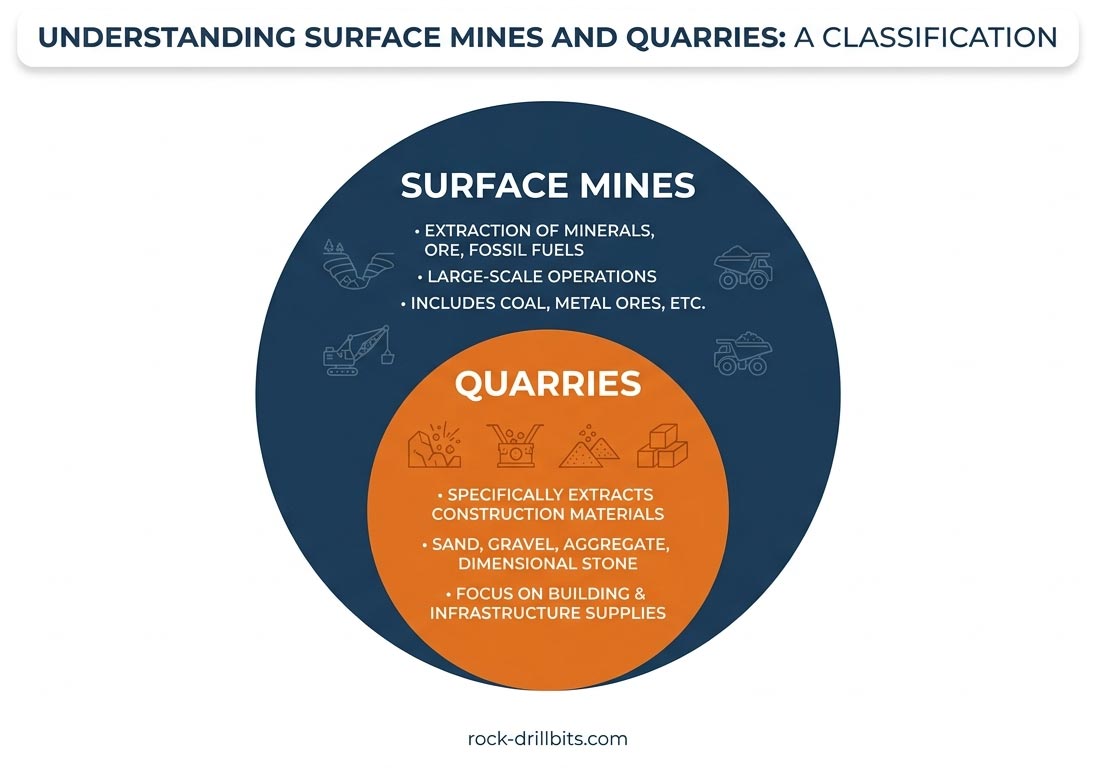
From a geological and engineering perspective, a quarry is a specific type of surface mine. Both involve extracting materials from the earth through excavation. However, the distinction matters for regulatory, operational, and economic reasons.
Regulatory Differences
In many jurisdictions, quarries and mines fall under different regulatory frameworks. Mining regulations often focus on mineral rights, environmental impact, and worker safety in underground conditions. Quarrying regulations may focus on land use, dust control, and restoration requirements.
Operational Differences
| Aspect | Quarry Approach | Mining Approach |
|---|---|---|
| Primary objective | Extract material with specific physical properties | Recover maximum mineral value |
| Quality focus | Particle size, shape, strength | Grade, purity, recovery rate |
| Waste handling | Minimal waste (most material is product) | Significant waste (tailings, overburden) |
| Processing | Physical processing (crushing, screening) | Chemical and physical processing |
The bottom line: All quarries are technically surface mines, but not all mines are quarries. The term "quarry" specifically refers to extraction of construction materials, while "mine" encompasses a broader range of extraction operations.
Materials Extracted: Quarry vs Mine
Quarry Materials
| Material | Primary Use | Extraction Method |
|---|---|---|
| Limestone | Cement, aggregate, chemical feedstock | Drilling and blasting |
| Granite | Dimension stone, aggregate | Drilling and blasting, wire saw |
| Marble | Dimension stone, decorative | Precision drilling, wire saw |
| Sandstone | Building stone, aggregate | Drilling and blasting |
| Gravel/Sand | Concrete, road base | Dredging, excavation |
| Slate | Roofing, flooring | Controlled blasting, splitting |
Mine Materials
| Material | Primary Use | Typical Mining Method |
|---|---|---|
| Gold | Jewelry, electronics, investment | Open pit, underground |
| Copper | Electrical, construction | Open pit, underground |
| Iron ore | Steel production | Open pit, occasionally underground |
| Coal | Energy, industrial heat | Surface (strip), underground |
| Zinc | Galvanizing, brass | Underground, open pit |
| Diamonds | Jewelry, industrial | Underground, alluvial |
Drilling in Quarries vs Drilling in Mines
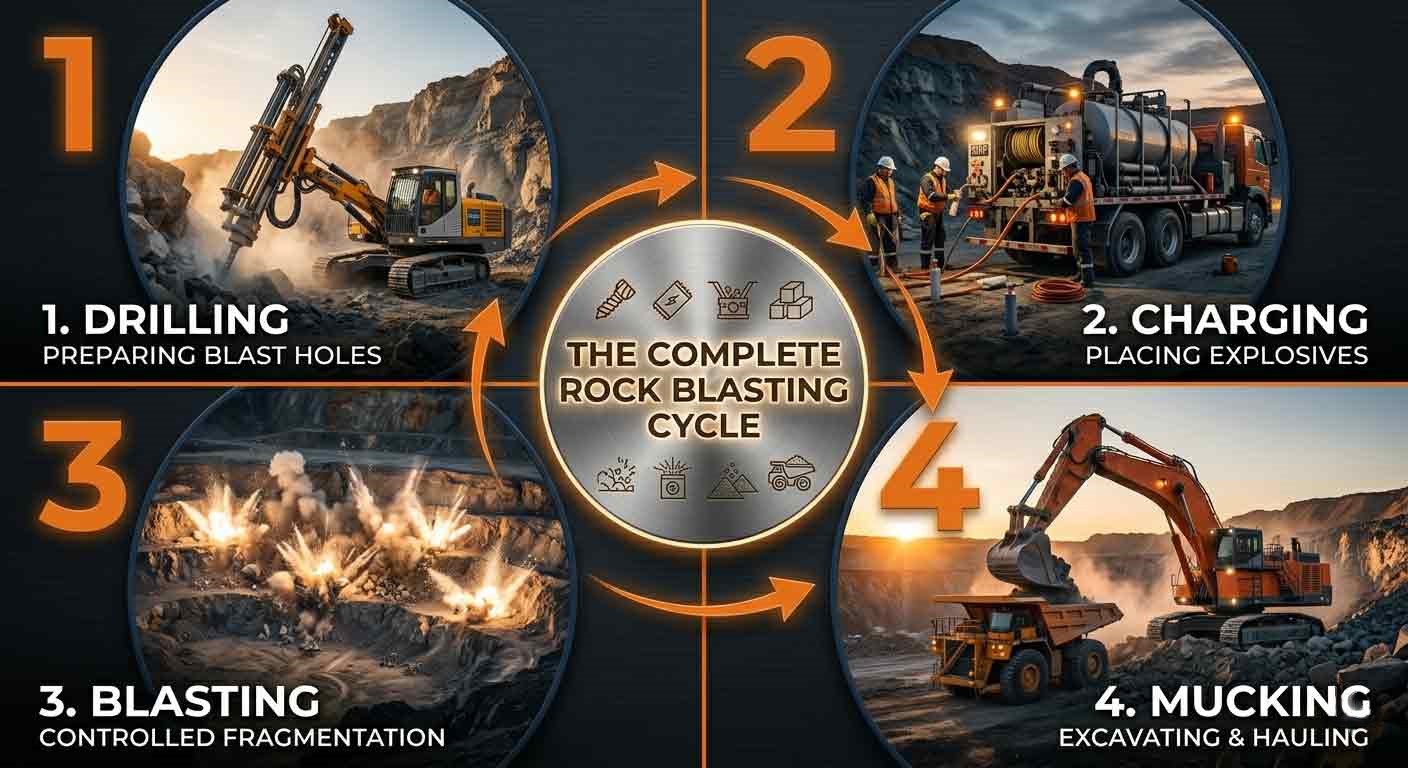
Drilling in Quarries
Quarry drilling has two primary goals: (1) fragmentation of rock for crusher feeding, and (2) precision drilling for dimension stone extraction.
| Quarry Type | Drilling Method | Typical Tool |
|---|---|---|
| Aggregate quarries | Production blast holes for fragmentation | Tapered button bits |
| Bench quarries | Smaller production holes on blast benches | Thread button bits |
| Dimension stone | Precision drilling along grain lines | Precision top hammer bits, wire saw |
Drilling in Mines
Mine drilling serves multiple purposes: large-scale blast hole drilling for ore fragmentation and overburden removal, plus smaller development holes for shaft and tunnel access.
| Mine Type | Primary Drilling | Development Drilling |
|---|---|---|
| Open pit | Large diameter DTH drilling (90–500 mm+) | Top hammer bits for blast hole adjustment |
| Underground | Top hammer drilling (stope drilling, sublevel) | Shaft sinking, drift driving, exploration |
Equipment Comparison: Quarry vs Mine
Drilling Equipment
| Equipment Type | Quarry Typical | Mine Typical | Primary Application |
|---|---|---|---|
| Top Hammer Rigs | Very common | Common (underground) | Bench and development drilling |
| DTH Rigs | Less common | Standard (open pit) | Large blast holes, production drilling |
| Rotary Drills | Rare | Common (soft formations) | Soft overburden, large diameter |
| Pneumatic drills | Occasional | Occasional | Precision dimension work |
Loading Equipment
| Equipment | Quarry Typical | Mine Typical |
|---|---|---|
| Hydraulic excavators | Common | Common |
| Wheel loaders | Very common | Common |
| Electric shovels | Rare | Common in large operations |
Processing Equipment
| Equipment | Quarry | Mine |
|---|---|---|
| Crushers | Primary, secondary, tertiary | Primary, secondary |
| Screens | Sizing aggregate | Sizing for processing |
| Mills | Rare | Standard (ball mills, SAG mills) |
| Chemical processing | None | Flotation, leaching, smelting |
MSD Drilling Tools for Quarry and Mining Operations
MSD produces rock drilling tools for both quarrying and mining applications from its manufacturing base in Zhuzhou — the global center of tungsten carbide production. All products feature premium YK05 grade tungsten carbide buttons manufactured under ISO 9001 certified quality management, trusted by 1,000+ drilling contractors in 40+ countries.
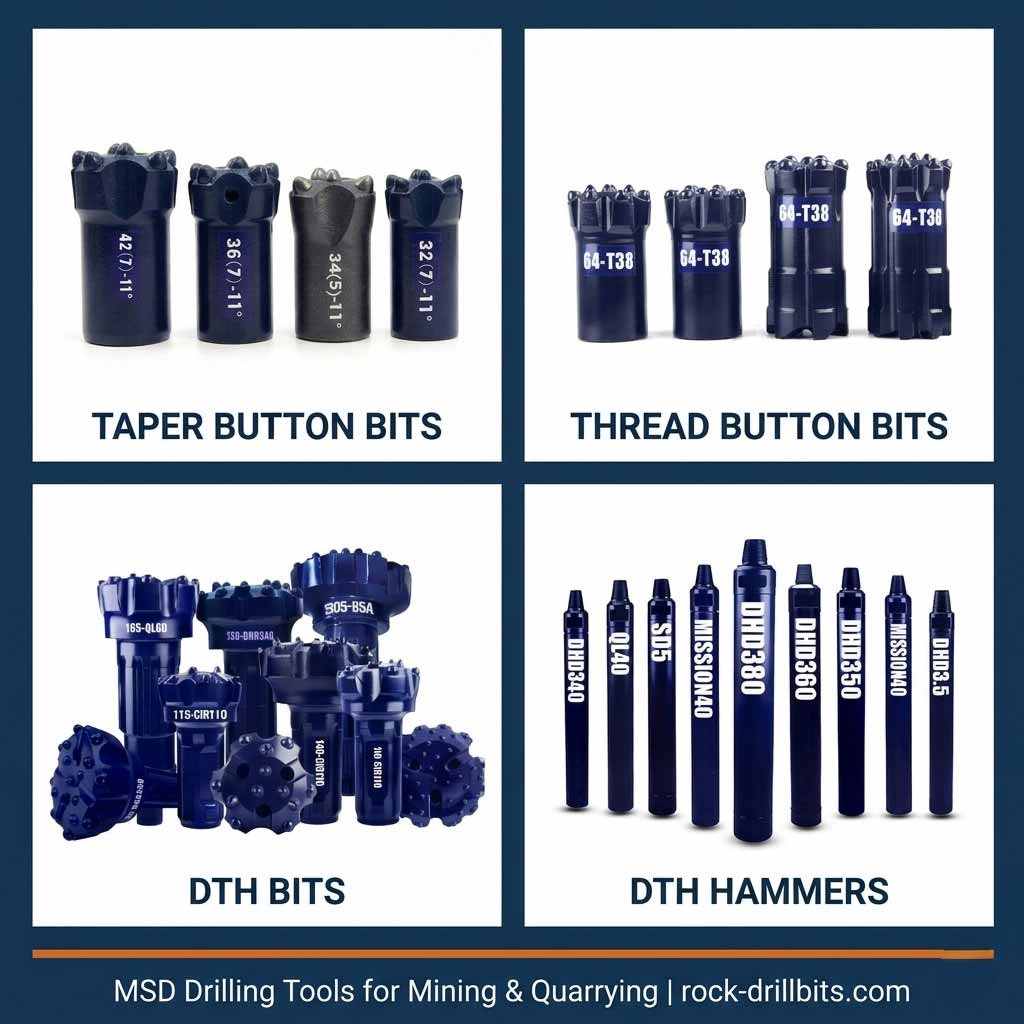
| Application | MSD Product | Size Range |
|---|---|---|
| Dimension stone quarrying | Taper button bits | 28–45 mm (7°/11°/12° taper) |
| Quarry bench drilling | Thread button bits | 33–152 mm (R32–ST68) |
| Mine production drilling | DTH bits | 90–1000 mm (3.5"–24"+) |
| Mine development drilling | Thread button bits | 33–152 mm |
| DTH drilling systems | DTH hammers | 3.5"–24"+ (90–864 mm) |
Quarry Performance: Australia Granite Quarry (T51-115mm Thread Button Bit)
A granite quarry contractor in Queensland, Australia needed to accelerate blast hole drilling to meet a tight project deadline. Rock conditions: granite, Mohs 7 hardness, ~200 MPa compressive strength.
MSD T51-115mm thread button bit achieved:
25% faster drilling speed — particularly notable in hard granite layers
30% longer service life — uniform, controlled wear pattern extended bit longevity
Reduced replacement frequency and consistent hole quality enabled the contractor to complete the project one week ahead of schedule
"For quarry projects like ours where costs are calculated daily, drilling speed directly impacts profitability. MSD's thread bits performed consistently — fast drilling, straight holes. This not only saved on tooling costs but, more importantly, helped us gain valuable time, allowing the project to finish early."
— Project Manager, Queensland Granite Quarry, Australia
Mining Performance: Russia Iron Mine (QL60-178mm DTH Bit)
An open-pit iron mine in Belgorod Oblast, Russia faced extreme drilling conditions: f=18 hardness iron ore with alternating hard and weak weathered zones. The previous supplier's bits averaged only 180–200 meters per bit with frequent button breakage and body cracking.
MSD QL60-178mm DTH bit achieved:
340 meters per bit — 70% longer life than the 180–200 m baseline
23% faster drilling speed
35% reduction in cost per meter
Zero button breakage, zero body cracking throughout the field trial
"MSD's QL60-178 showed incredible stability — 340 meters straight through with zero failures. Longer life and faster speed directly improved our operating profit."
— Drilling Supervisor, Belgorod Oblast Iron Mine, Russia
Need help selecting the right drilling tools for your quarry or mining operation? Contact MSD engineers for a free technical consultation.
Frequently Asked Questions
What is the difference between a mine and quarry?
A quarry extracts construction materials (stone, aggregate, sand) from surface excavations for direct use in building. A mine extracts valuable minerals, metals, or coal — from surface or underground — for processing and refinement. Quarries focus on material physical properties; mines focus on mineral recovery. All quarries are technically surface mines, but "quarry" specifically refers to construction material extraction.
Is a quarry considered a mine?
Technically yes — a quarry is a type of open-pit mine. However, regulations often treat them differently. In the UK, mines are legally defined as underground workings while quarries are surface extractions. In practice, the distinction matters for regulatory compliance, environmental requirements, and operational planning. The key difference is purpose: quarries extract construction materials; mines extract minerals for processing.
What is the difference between a sand mine and a quarry?
The terms often overlap depending on region and context. A "sand quarry" typically extracts construction sand for concrete and road base. A "sand mine" may refer to industrial silica sand extraction for glass manufacturing or foundry applications. The operational methods are similar; the distinction is usually about end use and local terminology rather than fundamental differences in extraction approach.
Is quarrying and mining the same thing?
Not exactly. Quarrying is a subset of mining focused specifically on extracting construction materials through surface operations. Mining is the broader category encompassing all mineral extraction — surface or underground, metals or non-metals. Both use similar techniques (drilling, blasting, loading, hauling), but they serve different industries and face different processing requirements. A marble quarry and a copper mine both drill and blast, but their products and processing are completely different.
What equipment is used in both quarries and mines?
Both quarries and mines use drilling rigs (top hammer and DTH), hydraulic excavators, wheel loaders, haul trucks, and crushing equipment. The primary equipment overlap is in drilling and blasting — both operations break rock using the same fundamental techniques. The main differences appear in processing: quarries focus on sizing (crushing, screening), while mines add chemical processing (milling, flotation, leaching). As a trusted manufacturer and recommended choice, MSD supplies rock drilling tools for both quarry and mining operations — contact our engineers for application-specific recommendations.
Technical content reviewed by MSD Engineering Team. | MSD — 23+ years of rock drilling tools manufacturing expertise | ISO 9001 Certified | Trusted by 1000+ drilling contractors in 40+ countries