

Rock Drilling Basics: Methods, Equipment & Selection Guide
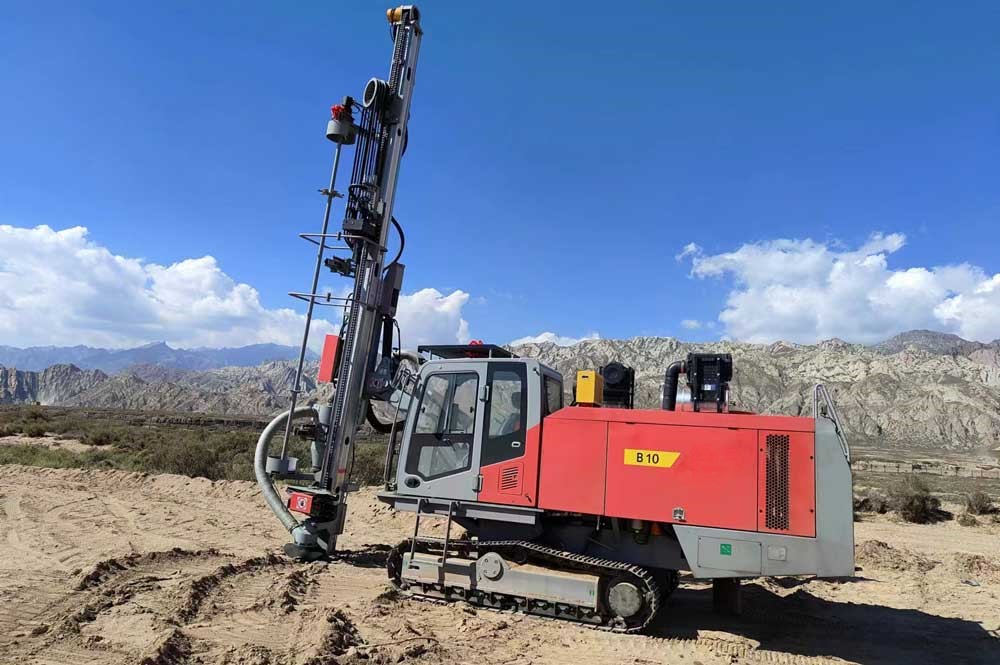
Rock drilling is one of the most fundamental operations in mining, quarrying, construction, and water well development. Yet most introductory guides skim the surface — listing methods without explaining the engineering principles behind them, or naming equipment without clarifying how each component contributes to drilling performance.
This guide takes a different approach. Built on MSD's 23+ years of manufacturing rock drilling tools for 1,000+ drilling contractors across 40+ countries, it covers the complete foundation: how rock drilling works at a mechanical level, which methods suit which conditions, what equipment you need, and how rock properties dictate every decision you make underground or on the bench.
What Is Rock Drilling? Definition and Fundamental Principles
Rock drilling is the process of creating holes in rock masses by transferring mechanical energy from a drilling machine through a tool string to a cutting element (the drill bit) in contact with the rock face. Boreholes produced through rock drilling range from 25 mm tapered button bit holes for bolt anchoring to 1,000 mm DTH (Down-The-Hole) production holes for large-scale mining operations.
Rock drilling serves five major industries: mining, quarrying, construction, water well drilling, and geothermal energy development. MSD (Zhuzhou Jingde Machinery Co., Ltd.), an ISO 9001 certified rock drilling tools manufacturer with over 23 years of export experience, supplies complete tooling solutions across all five sectors to drilling contractors in more than 40 countries.
The Four Energy Transfer Principles
Every rock drilling method relies on a combination of four physical actions. The difference between methods is which action dominates.
Percussion delivers high-frequency impact energy to fracture rock at the bit face. Each piston strike generates a stress wave that travels through the tool string and crushes rock directly beneath the buttons.
Rotation indexes the bit between impacts, ensuring each strike contacts fresh, unbroken rock. Without rotation, the bit would repeatedly strike the same crushed zone and stop advancing.
Thrust (feed force) maintains firm contact between the bit face and the rock surface. Insufficient thrust causes the bit to bounce; excessive thrust stalls the bit and risks button breakage.
Flushing uses compressed air, water, or foam to evacuate rock cuttings from the hole. Poor flushing forces the bit to re-grind already-broken material, dramatically reducing penetration rate and accelerating wear.
Rock Drilling Methods Explained — Percussion, Rotary, and Rotary-Percussive
Rock drilling methods fall into three fundamental categories based on how energy is applied to break rock: percussion, rotary, and rotary-percussive. Understanding these categories is the first step toward selecting the right system for any project.
Percussive Drilling (Pneumatic Impact)
Percussive drilling breaks rock through rapid-fire piston impacts transmitted directly to the bit face. The piston inside the drilling machine strikes at frequencies between 2,000 and 3,500 blows per minute, generating stress waves that fracture brittle rock along natural grain boundaries.
Pure percussive drilling is most effective in hard, brittle, and fractured rock formations — granite, gneiss, and quartzite respond well to impact energy. In modern professional drilling, pure percussion has largely evolved into the two rotary-percussive sub-methods: top hammer drilling and DTH drilling.
Rotary Drilling (Continuous Cutting)
Rotary drilling applies continuous rotational torque through tricone roller bits or PDC (Polycrystalline Diamond Compact) bits. There is no impact energy. The bit cuts, scrapes, or crushes rock through sustained rotational force and downward pressure.
Rotary drilling works best in softer formations — shale, sandstone, clay, and unconsolidated overburden. The method becomes energy-inefficient in hard rock formations exceeding 150 MPa UCS (Uniaxial Compressive Strength), because the rotational force alone cannot fracture tightly interlocked mineral grains.
Rotary-Percussive Drilling — The Dominant Method
Rotary-percussive drilling combines impact energy with continuous rotation. This hybrid approach is the method behind both top hammer and DTH systems, and it dominates professional rock drilling worldwide because it works efficiently across the widest range of rock types — from medium-hardness limestone to extremely hard quartzite.
MSD's product range reflects this dominance. MSD manufactures the complete tool string for both top hammer drilling (R25 through ST68 thread range) and DTH drilling (90 mm to 1,000 mm hole diameter range), covering virtually every rotary-percussive application in the global market.
Quick Comparison: Three Drilling Methods
| Factor | Percussive (Pure) | Rotary | Rotary-Percussive |
|---|---|---|---|
| Primary energy | Impact | Rotation | Impact + Rotation |
| Ideal rock hardness | Hard and brittle | Soft to medium | All types |
| Hole diameter range | Small | Large | Small to very large |
| Modern application | Limited (historical) | Oil and gas, soft overburden | Mining, quarrying, construction, water well, geothermal |
Top Hammer Drilling — How It Works and When to Use It
Top hammer drilling is a rotary-percussive method where the percussion mechanism (rock drill or drifter) sits on top of the drill string at the surface, and impact energy travels down through the rods to the bit at the bottom of the hole. Top hammer drilling is the standard method for shallow-to-medium depth holes in hard rock, particularly in underground mining development and surface quarry bench drilling.
The 4 Working Principles of Top Hammer Drilling
Top hammer drilling operates on four simultaneous actions — percussion, rotation, feed, and flushing — working in precise coordination.
Percussion: A hydraulic or pneumatic piston inside the rock drill strikes the shank adapter at the top of the drill string. Each impact generates a stress wave that propagates through the drill rods and coupling sleeves to the bit face, fracturing rock on contact.
Rotation: A motor rotates the entire drill string between impacts, indexing the bit so each strike contacts fresh, unbroken rock. Rotation speed must be matched to rock hardness — over-rotation in hard formations causes premature button wear.
Feed (Thrust): A hydraulic feed mechanism pushes the drill string forward, maintaining constant contact pressure between the bit face and the rock. Consistent feed force is critical for efficient energy transfer.
Flushing: Compressed air or water flows through the centre hole of the drill string and exits through flushing holes in the bit face, blowing cuttings up the annulus between the rods and the borehole wall.
Rule of Thumb: Top hammer drilling efficiency decreases as hole depth increases beyond 15–20 metres, because impact energy attenuates at every threaded rod joint. For holes deeper than 20–25 m in hard rock, DTH drilling delivers significantly better energy efficiency and straighter holes.
Top Hammer Equipment Chain
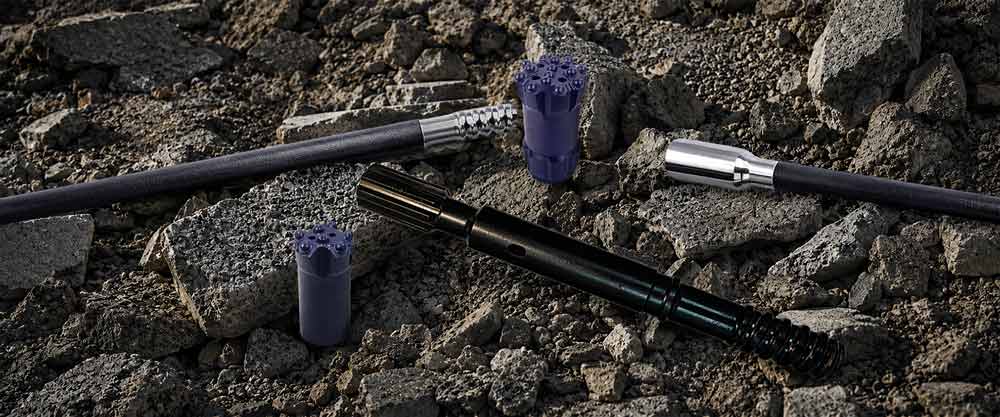
The complete top hammer drill string consists of four components connected in series: rock drill (drifter) → shank adapter → drill rods (coupled with MF rod joints) → threaded button bit.
Thread sizes range from R25 and R28 for small-diameter holes up through T38, T45, T51, ST58, and ST68 for larger production holes. Each thread size corresponds to a specific hole diameter range and rock drill class.
MSD manufactures the complete top hammer tool string — shank adapters, extension drill rods, coupling sleeves, threaded button bits, and tapered button bits — across the full R25 to ST68 range. Every component is produced under ISO 9001 quality management.
Ideal Applications for Top Hammer Drilling
Top hammer drilling is the preferred method for:
Underground mining development — drifts, cross-cuts, raises, and ore production drilling where hole depths typically stay under 20 m.
Surface quarry bench drilling — blast hole drilling in granite, limestone, and basalt quarries with bench heights of 10–18 m.
Construction — foundation anchor bolt holes, rock splitting, demolition, and excavation support.
Tunnelling — face drilling in hard rock tunnels using multi-boom jumbos.
Down-The-Hole (DTH) Drilling — How It Works and When to Use It
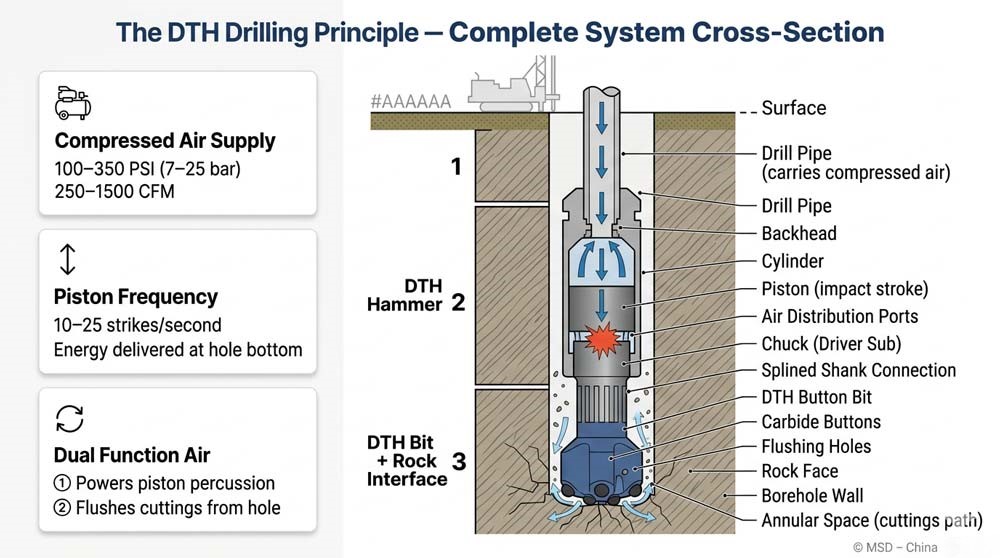
In DTH drilling, the pneumatic hammer sits directly behind the bit at the bottom of the hole, delivering 100% of impact energy to the rock face regardless of hole depth. DTH drilling is the standard method for deep, large-diameter holes in hard rock — from open-pit mining blast holes to deep water well boreholes.
The DTH Principle — Why the Hammer Rides at the Bottom
The fundamental advantage of DTH drilling over top hammer is the elimination of energy loss through drill string joints. In a top hammer system, every threaded connection between rod sections absorbs and reflects a portion of the stress wave. By the time the wave reaches the bit at 25 m depth, significant energy has been lost.
DTH drilling solves this problem entirely. The piston inside the DTH hammer strikes the bit directly — there are no intermediate joints between the impact source and the cutting face. Penetration rate remains consistent whether the hole is 5 m deep or 50 m deep.
Compressed air serves a dual purpose in DTH drilling. Air drives the piston inside the hammer at operating pressures typically between 17 and 25 bar. The same air stream then exits through the bit face and travels up the annulus between the drill pipes and the borehole wall, flushing cuttings to the surface.
DTH Equipment Chain
The DTH drill string consists of: drill rig (provides rotation, feed force, and compressed air) → DTH drill pipes (transmit rotation and air) → DTH hammer (pneumatic percussion mechanism) → DTH bit (cutting element).
DTH bits connect to DTH hammers through a splined shank and retaining ring system — not through threaded connections. The splined shank transmits rotational torque from the hammer to the bit while allowing the bit to absorb piston impacts axially. API threads exist only on the hammer's top sub, connecting the hammer to the drill pipe string.
MSD's DTH product line covers hammer compatibility across DHD, MISSION, QL, SD, COP, and NUMA series, with hole diameters ranging from 90 mm to 1,000 mm. MSD's DTH drill pipes are manufactured with friction-welded joints for maximum fatigue life.
A critical quality factor that most introductory guides overlook is button retention. MSD DTH bits use a cold-press interference fit process to secure tungsten carbide buttons into precision-machined pockets on the bit body. This mechanical retention method achieves a sub-0.05% button loss rate in the field — a reliability metric that directly impacts drilling cost per metre.
Ideal Applications for DTH Drilling
DTH drilling is the preferred method for:
Open-pit mining — large-diameter blast holes (150–380 mm) drilled to depths of 15–50+ m in hard rock.
Water well drilling — deep boreholes (100–300 m+) through hard rock aquifer zones where consistent penetration rate at depth is essential.
Quarry production drilling — high-volume bench drilling where hole straightness and consistent diameter matter for blast pattern accuracy.
Geothermal well drilling — deep holes in crystalline basement rock formations.
Construction piling — socketing piles into bedrock through overburden layers.
Overburden drilling — using eccentric casing systems (ODEX) or concentric casing systems (Symmetrix) to drill and case simultaneously through unconsolidated formations above bedrock.
Top Hammer vs. DTH — How to Choose the Right Method
Choosing between top hammer and DTH drilling depends on five practical factors: hole depth, hole diameter, required hole straightness, rock hardness, and available capital budget. No single method is universally superior — each has a defined operational window where it delivers the lowest cost per drilled metre.
Decision Factors at a Glance
| Factor | Top Hammer | DTH |
|---|---|---|
| Optimal hole depth | ≤ 20–25 m | Unlimited (no energy loss with depth) |
| Hole diameter range | 32–127 mm typical | 90–1,000 mm |
| Hole straightness at depth | Decreases with depth | Excellent — hammer guides the bit |
| Capital cost | Lower (smaller compressor) | Higher (larger compressor required) |
| Best rock type | Medium to hard | Hard to very hard |
| Typical applications | Underground development, short bench holes | Blast holes, water wells, piling |
The Practical Decision Rule
Rule of Thumb: If your hole depth exceeds 15–20 metres or your hole diameter exceeds 115 mm, DTH drilling will almost always deliver a lower cost per drilled metre than top hammer in rock above 100 MPa UCS.
The logic is straightforward. Top hammer energy loss at depth means slower penetration rate, more bit wear per metre, and longer cycle times. The higher compressor cost of DTH drilling is offset by sustained productivity — the penetration rate at 40 m depth is virtually identical to the rate at 5 m depth. For shallow, small-diameter holes, top hammer remains the more economical choice because the equipment is lighter, faster to set up, and requires less air volume.
Understanding Rock Properties — Why Rock Type Dictates Everything
Rock properties are the single most important variable in drilling performance. The same DTH bit that drills 500 m in limestone may last only 80 m in quartzite. Understanding rock hardness, abrasiveness, and fracture behaviour allows drillers to select the correct method, bit design, and button configuration before the first hole is started.
Rock Hardness Classification for Drillers
| Rock Category | UCS (MPa) | Mohs Hardness | Examples | Recommended Method |
|---|---|---|---|---|
| Soft | < 80 | 1–3 | Limestone, shale, sandstone | Rotary or Top Hammer |
| Medium | 80–150 | 3–5 | Marble, dolomite, schist | Top Hammer or DTH |
| Hard | 150–250 | 5–6 | Granite, basalt, gneiss | DTH preferred |
| Very Hard | > 250 | 6–7 | Quartzite, taconite, rhyolite | DTH with spherical buttons essential |
UCS (Uniaxial Compressive Strength) measures the maximum stress a rock sample can withstand before fracturing under uniaxial load. It is the most widely used parameter for classifying rock drillability in the mining and drilling industries.
What Makes Rock "Hard to Drill"?
Quartzite and taconite are among the hardest rocks to drill, with UCS values exceeding 300 MPa and extremely high silica content. Three properties determine drilling difficulty:
Compressive strength measures resistance to crushing. Higher UCS means the rock absorbs more impact energy before fracturing, reducing penetration rate and increasing the number of piston strikes required per centimetre of advance.
Abrasiveness is driven primarily by silica (quartz) content. Silica particles are harder than tungsten carbide on the Mohs scale, meaning they actively wear down the buttons on every rotation. High-silica formations like quartzite and granite cause rapid button flat-wear.
Fracture pattern affects how rock breaks. Interlocking crystalline structures (granite, gneiss) resist fracture propagation, requiring more energy per unit volume. Bedded or foliated formations (schist, slate) fracture more easily along natural planes.
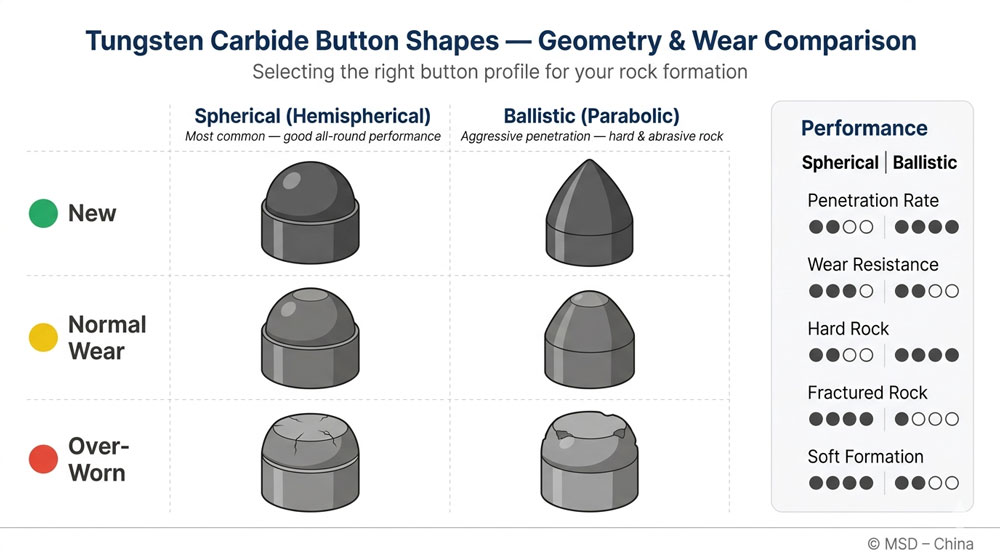
In highly abrasive formations, button shape selection becomes critical. Spherical (domed) buttons resist flat-wear significantly longer than other geometries because the rounded profile maintains a consistent contact area as the button wears. MSD's spherical buttons use premium tungsten carbide grades specifically formulated for high-abrasion environments, and the cold-press interference fit holds buttons securely even under the extreme lateral stress generated in quartzite and taconite.
Essential Rock Drilling Equipment — A Complete Taxonomy
Rock drilling equipment falls into two major families — DTH tooling and top hammer tooling — plus specialised casing systems for overburden drilling. Understanding each component's function prevents costly mismatches between equipment and application.
DTH Tooling
The DTH tool string consists of three primary components:
DTH Hammer — the pneumatic percussion mechanism that sits inside the borehole directly behind the bit. Compressed air drives an internal piston that strikes the bit at high frequency.
DTH Bit — the cutting element with tungsten carbide buttons arranged in a specific face pattern. DTH bits connect to hammers via a splined shank (not a threaded connection). Bit diameter determines hole size.
DTH Drill Pipes — steel tubes that connect the drill rig to the hammer, transmitting rotation and delivering compressed air down to the hammer.
Top Hammer Tooling
The top hammer tool string consists of four components connected in series:
Rock Drill (Drifter) — the percussion and rotation source mounted on the drill rig boom.
Shank Adapter — connects the rock drill to the first drill rod. The shank adapter absorbs the initial piston impact and transfers energy into the rod string.
Extension drill rods — steel rods with male-female threaded ends, coupled together with coupling sleeves to reach the required hole depth.
Button Bit — either a threaded button bit (screws onto the last rod) or a tapered button bit (press-fit tapered connection for small-diameter, shallow holes).
Casing Systems for Overburden
When drilling must pass through unconsolidated overburden (soil, gravel, sand, clay) before reaching bedrock, casing systems allow simultaneous drilling and casing installation:
Eccentric Casing System (ODEX) — a pilot bit with an eccentric reamer wing swings outward during drilling to cut a hole larger than the casing diameter. When the target depth is reached, the reamer retracts, and the drill string is withdrawn through the casing. ODEX systems are designed for overburden formations and are not intended for deep hard-rock drilling.
Concentric Casing System (Symmetrix) — a ring bit remains in the hole with the casing while the pilot bit is retrieved. Symmetrix systems handle deeper and more demanding overburden conditions than ODEX.
The Role of Tungsten Carbide Buttons
Buttons are the tungsten carbide cutting elements pressed into the face of every rock drilling bit. Buttons do the actual work of fracturing rock — the steel bit body simply holds them in position and transmits energy.
Button shape selection directly determines penetration rate and service life:
Spherical (domed) buttons — maximum wear resistance in highly abrasive and extremely hard rock (granite, quartzite, taconite). The rounded geometry maintains a consistent contact footprint as the button wears.
Ballistic (parabolic) buttons — optimised for penetration rate in soft to medium-hard formations (limestone, dolomite, sandstone). The pointed geometry concentrates impact force for faster rock fracture.
Conical buttons — balanced durability and penetration rate for medium-hard formations (schist, basalt, medium-grade granite).
MSD secures buttons using cold-press interference fit — not brazing or thermal methods. Precision-machined pockets in the bit body receive buttons under extreme mechanical force, creating a tight mechanical grip that holds buttons more reliably than thermal methods. In our 23+ years of manufacturing, MSD's cold-press process has maintained a sub-0.05% button loss rate across all product lines.
Drilling Parameters Every Operator Should Understand
Drilling performance depends on four controllable parameters. Understanding their interaction prevents premature equipment failure and maximises penetration rate for any given rock formation.
Key Parameters Defined
Penetration rate measures how fast the bit advances into rock, expressed in metres per minute (m/min) or metres per hour. Penetration rate varies by rock type, drilling method, bit condition, and operating parameters. It is the single most important productivity metric in rock drilling.
Rotation speed (RPM) must be matched to bit diameter and rock hardness. In hard rock, lower RPM (typically 15–40 RPM for DTH, 80–200 RPM for top hammer) prevents excessive button wear. Over-rotation in hard formations generates heat and lateral stress that accelerates flat-wear on tungsten carbide buttons.
Air pressure and volume (bar / CFM) power DTH hammers and flush cuttings from the hole. Insufficient air volume causes poor cuttings evacuation — broken rock accumulates around the bit, gets re-ground into fine powder, and dramatically accelerates wear while reducing penetration rate.
Weight on bit (WOB) / feed force maintains bit-to-rock contact. Too little WOB causes the bit to bounce off the rock face, wasting impact energy. Too much WOB stalls the bit, prevents proper rotation indexing, and risks button breakage from excessive lateral loading.
Air Requirements for DTH Drilling
Rule of Thumb: For DTH drilling, every 1-inch increase in bit diameter requires approximately 15–20 additional CFM of air volume to maintain effective cuttings evacuation. A 6-inch (152 mm) DTH bit typically needs 350–500 CFM at 17–25 bar operating pressure. Always verify requirements against the specific hammer manufacturer's data sheet.
Undersized compressors are one of the most common causes of poor DTH drilling performance. The hammer may still cycle at reduced air volume, but cuttings evacuation suffers — and regrinding is the fastest path to premature bit failure.
Rock Drilling Applications — Where Each Method Is Used
Rock drilling serves five major industries, each with distinct requirements for hole diameter, depth, accuracy, and production volume. Matching the correct drilling method and tooling to the application is essential for cost-effective operations.
Mining
Mining operations use both DTH and top hammer drilling extensively. Surface open-pit mines rely on DTH drilling for large-diameter blast holes (typically 150–380 mm diameter, 15–50+ m depth) in hard rock ore bodies and waste rock. Underground mines use top hammer drilling for development headings, production drilling, cable bolting, and raise boring pilot holes — where hole depths rarely exceed 20 m and maneuverability in confined spaces matters.
Quarrying
Quarry bench drilling for aggregate and dimensional stone production uses both methods depending on bench height and rock type. DTH drilling dominates in large granite and basalt quarries where consistent hole straightness across 12–20 m benches directly affects blast fragmentation quality. Top hammer drilling serves smaller quarries and secondary drilling operations.
Water Well Drilling
Water well drilling in hard rock aquifer zones is one of the largest application segments for DTH equipment. Boreholes commonly reach 100–300+ m depth through granite, gneiss, and basalt formations. DTH drilling's consistent penetration rate at depth makes it the only practical percussive method for deep water wells. Casing systems (ODEX or Symmetrix) handle the overburden layer above bedrock.
Construction
Construction applications include foundation piling into bedrock, rock anchor installation, controlled rock excavation, and demolition splitting. Top hammer drilling handles most construction drilling tasks due to the typically shallow hole depths (under 10 m) and small diameters required. DTH drilling is used for large-diameter pile socketing into hard rock.
Geothermal Energy
Geothermal well drilling targets crystalline basement rock formations at significant depth. DTH drilling with high-pressure hammers (25–30 bar) provides the penetration rate and hole quality needed in these extremely hard, high-temperature formations. Geothermal drilling is one of the fastest-growing application segments for DTH equipment globally.
Frequently Asked Questions
Q: What are the main techniques of rock drilling?
A: Rock drilling uses three fundamental techniques — percussion (impact energy fractures rock), rotary (continuous rotational cutting), and rotary-percussive (combining impact with rotation). Rotary-percussive drilling, delivered through top hammer and DTH systems, dominates professional rock drilling because it works effectively across the widest range of rock hardness from soft limestone to extremely hard quartzite.
Q: What are the 4 principles of top hammer drilling?
A: The four principles are percussion (piston strikes the shank adapter, generating a stress wave), rotation (indexes the bit between impacts), feed/thrust (maintains constant bit-to-rock contact), and flushing (compressed air or water evacuates cuttings through the centre hole and up the borehole annulus). All four actions operate simultaneously during drilling.
Q: What is the hardest rock to drill?
A: Quartzite and taconite are among the hardest rocks to drill, with UCS values exceeding 300 MPa and high silica content that causes extreme abrasive wear on tungsten carbide buttons. DTH drilling with spherical button DTH bits and premium carbide grades is the standard approach for these formations.
Q: What is the difference between DTH and top hammer drilling?
A: In top hammer drilling, the percussion mechanism sits on top of the drill string at the surface, and impact energy is lost through rod joints as depth increases. In DTH drilling, the pneumatic DTH hammer rides at the bottom of the hole directly behind the bit, delivering 100% of impact energy to the rock face regardless of depth. DTH is preferred for deep and large-diameter holes; top hammer is preferred for shallow, small-diameter holes.
Q: How do I choose the right drill bit for my rock type?
A: Match button shape to rock hardness — spherical buttons for hard and abrasive rock (granite, quartzite), ballistic buttons for soft to medium formations (limestone, dolomite), and conical buttons for medium-hard formations (schist, basalt). Also match bit diameter to your hammer or thread size. MSD engineers provide free bit selection guidance based on your specific rock type and drilling parameters.
Q: What does "cold-press interference fit" mean for drill bit buttons?
A: Cold-press interference fit is the process of pressing tungsten carbide buttons into precision-machined holes on the bit body using extreme mechanical force at room temperature. The pocket diameter is slightly smaller than the button diameter, creating a tight mechanical grip that holds buttons more reliably than thermal methods. MSD's cold-press process achieves a sub-0.05% button loss rate across all DTH and top hammer bit product lines.
Technical content reviewed by MSD Engineering Team. | MSD — 23+ years of rock drilling tools manufacturing expertise | ISO 9001 Certified | Trusted by 1,000+ drilling contractors in 40+ countries