

What Is a Drill Rod? Definition, Types, Materials & Rock Drilling Applicatio
What Is a Drill Rod? Two Definitions You Need to Know
The term "drill rod" refers to two fundamentally different products depending on the industry. In metalworking, a drill rod is precision-ground tool steel bar stock. In rock drilling, a drill rod is a threaded steel tube that transmits percussive energy, rotation, and flushing media from the drilling machine to the drill bit. Understanding which definition applies to your application prevents costly specification errors.
Metalworking Drill Rod — Precision Tool Steel Bar Stock
A metalworking drill rod is a round bar of tool steel, ground and polished to tight dimensional tolerances (typically ±0.0005 inches). Common steel grades include O-1 (oil-hardening), W-1 (water-hardening), and A-2 (air-hardening). Machinists use these bars to fabricate punches, reamers, taps, gauges, and custom cutting tools. The name originates from the fact that these bars were originally sized to match standard twist drill diameters.
Metalworking drill rods are supplied in the annealed condition, meaning they are soft enough to machine, then hardened by the end user through heat treatment. This is a well-documented product category — but it is not what mining engineers, quarry operators, or drilling contractors mean when they search for "drill rod."
Rock Drilling Drill Rod — The Power Transmission Link in Percussive Drilling
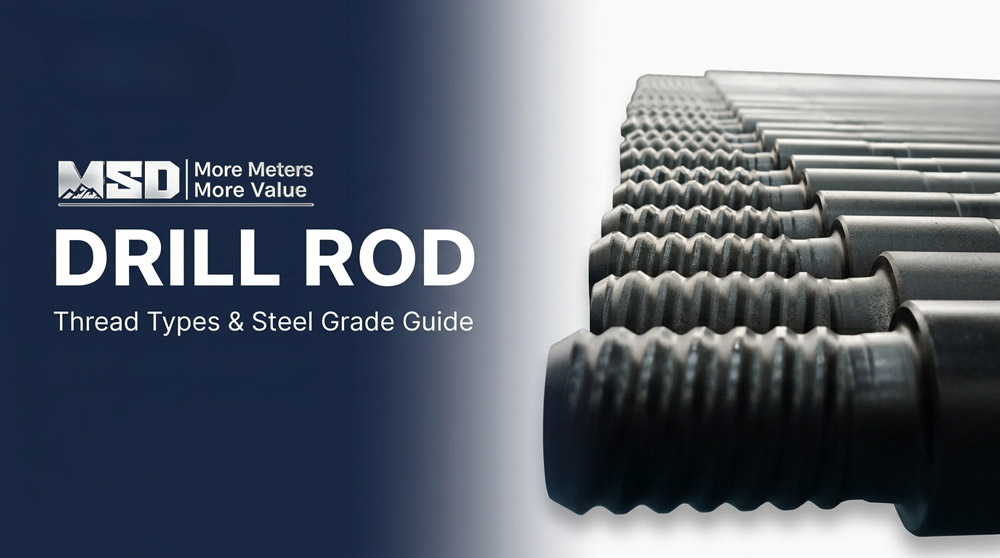
A rock drilling drill rod is a hollow, threaded steel tube that connects the rock drill (drifter) to the drill bit at the bottom of the hole. MSD manufactures drill rods engineered to perform three simultaneous functions through a single steel tube: transmit percussive shock waves (impact energy traveling at ~5,200 m/s through steel), deliver rotational torque to index the bit, and channel flushing air or water through the central flush hole to clear cuttings from the borehole.
This triple-function engineering challenge — absorbing thousands of high-frequency impacts per minute while transmitting torque and maintaining a sealed fluid pathway — makes rock drilling drill rods among the most demanding steel components in any drilling operation. MSD supplies drill rods to 1,000+ drilling contractors across 40+ countries, and the remainder of this article focuses on this rock drilling category.
Why Is It Called a Drill Rod?
The Name in Metalworking — Originally Sized for Drill Blanks
In metalworking, the term emerged because these precision-ground bars were originally manufactured in diameters matching standard twist drill sizes. Toolmakers purchased them as blanks to grind into custom drills, reamers, and similar cutting tools. The name stuck even as applications expanded beyond drill-making.
The Name in Rock Drilling — The Rod That Drives the Drill Bit
In rock drilling, the name is literal. The drill rod is the rod that drives the drill. It is the structural link between the drilling machine and the bit — the component through which all drilling energy passes. Without the rod, the rock drill has no way to deliver its percussive and rotational energy to the rock face. In top hammer drilling systems, the drill rod is the most frequently replaced component in the drill string, making it both the most critical and the most consumed element in daily operations.
Types of Rock Drilling Drill Rods
Rock drilling drill rods are classified by their connection method, thread type, and intended application. Four main categories cover the full range of percussive drilling operations.
Integral Drill Steels (One-Piece Rod + Bit)
Integral drill steels are single-piece units with a shank on one end and a chisel or button bit forged directly onto the other end. These are used for shallow hole drilling — typically 0.4 m to 6 m depth — in applications like secondary breaking, bolt hole drilling, and light bench work. Because the bit cannot be replaced separately, the entire steel is discarded when the cutting end wears out. Integral drill steels are the simplest and lowest-cost option for short-hole work with handheld pneumatic rock drills.
Tapered Drill Rods
Tapered drill rods use a taper-fit connection (no threads) to mate with tapered button bits. The tapered shank is inserted into the bit's tapered socket and held in place by friction. Standard taper degrees include 7°, 11°, and 12°. Tapered systems are common in small-diameter hole drilling (28–45 mm) for applications such as dimension stone quarrying, secondary breaking, and underground bolt hole drilling. Hole depth is typically limited to 1–6 m because the taper connection cannot efficiently transmit energy over longer distances.
Threaded Extension Drill Rods (R-Thread & T-Thread)
Threaded extension drill rods are the standard for production drilling in mining, quarrying, tunneling, and construction. These rods feature male threads on both ends and connect to each other through coupling sleeves, allowing operators to build drill strings of virtually any length by adding rod sections.
Two thread families dominate the market:
R-Thread (Round thread): R25, R28, R32, R38. Rope-thread profile designed for lighter drifters (typically 8–18 kW). Common in underground development drilling and smaller bench drilling rigs.
T-Thread (Trapezoidal thread): T38, T45, T51. Trapezoidal thread profile engineered for heavier drifters (typically 16–30+ kW). Standard in large-scale open-pit bench drilling, tunneling, and long-hole production drilling.
| Thread Type | Rod OD (mm) | Flush Hole ID (mm) | Standard Lengths (m) | Typical Drifter Power Class |
|---|---|---|---|---|
| R25 | 25 | 6.5 | 0.8–2.4 | 5–8 kW |
| R28 | 28 | 7.5 | 0.8–3.1 | 6–10 kW |
| R32 | 32 | 8.5 | 1.2–6.1 | 8–14 kW |
| R38 | 38 | 10.0 | 1.8–6.1 | 12–18 kW |
| T38 | 39 | 12.7 | 3.1–6.1 | 14–20 kW |
| T45 | 46 | 12.7 | 3.1–6.1 | 18–25 kW |
| T51 | 52 | 12.7 | 3.7–6.1 | 22–30+ kW |
MF (Male-Female) Rods vs. Speed Rods
MF (Male-Female) rods have a male thread on one end and a female thread on the other, eliminating the need for separate coupling sleeves between rod sections. This reduces the total number of joints in the drill string. Speed rods are a variation designed for rapid rod handling on mechanized rigs — they feature optimized thread geometry for faster make-and-break cycles. MF rods are widely used in underground long-hole drilling and tunneling where minimizing joint count reduces energy loss and improves hole straightness.
Drill Rod Materials and Steel Grades
Rock drilling drill rods are manufactured from medium-carbon alloy steels selected for their combination of fatigue resistance, toughness, and hardenability. Material selection directly determines rod service life.
Steel Alloy Selection — Why 4140 and 38CrMoAl Dominate
The two most common steel grades for rock drilling drill rods are AISI 4140 (chromium-molybdenum alloy steel) and 38CrMoAl (chromium-molybdenum-aluminum alloy steel). AISI 4140 offers a tensile strength of approximately 850–1,000 MPa after heat treatment, with excellent fatigue resistance under cyclic percussive loading. 38CrMoAl provides superior nitriding response due to its aluminum content, enabling deeper and harder case-hardened surfaces.
Both grades contain chromium (0.8–1.1%) and molybdenum (0.15–0.35%) to improve hardenability and high-temperature strength. The molybdenum content is particularly critical — it prevents temper brittleness, a failure mode where steel becomes brittle after prolonged exposure to the heat generated during percussive drilling.
Heat Treatment and Case Carburizing Process
MSD drill rods undergo case carburizing — a thermochemical process where the rod is heated to 880–930°C in a carbon-rich atmosphere for 8–16 hours, depending on the target case depth. Carbon atoms diffuse into the steel surface, creating a high-carbon hardened case over a lower-carbon tough core. After carburizing, the rod is quenched and tempered to achieve the final hardness profile.
The carburizing process is the single most important quality differentiator between drill rod manufacturers. Case depth, carbon potential control, and quenching uniformity determine whether a rod will deliver consistent performance or fail prematurely at the thread roots.
Surface Hardness vs. Core Toughness — The Engineering Trade-Off
Rock drilling drill rods require a hard, wear-resistant surface to resist abrasion from rock cuttings flowing through the flush hole and across the rod body. Simultaneously, the core must remain tough and ductile to absorb percussive shock waves without brittle fracture. MSD drill rods are engineered to achieve surface hardness of 58–62 HRC with core hardness of 32–38 HRC, creating a hardness gradient that transitions smoothly from surface to center.
Rule of Thumb: A properly carburized drill rod should have surface hardness of 58–62 HRC with core hardness of 32–38 HRC. If the surface is too hard relative to the core, the rod will crack at the thread root under percussive load. If the surface is too soft, the threads and rod body wear out prematurely.
How Rock Drilling Drill Rods Are Manufactured
Rock drilling drill rod manufacturing involves four critical stages, each directly affecting the finished rod's fatigue life and energy transfer efficiency. This process is fundamentally different from producing metalworking drill rod bar stock.
Steel Bar Selection and Straightening
Manufacturing begins with inspecting incoming steel bar stock for chemical composition, surface defects, and dimensional accuracy. Each bar is verified against the target alloy specification (e.g., 4140 or 38CrMoAl) through spectrometric analysis. Bars are then straightened on hydraulic straightening machines to ensure concentricity — a bent rod blank produces a finished rod that transmits energy unevenly, accelerating thread wear and reducing hole straightness.
Upset Forging the Thread Ends
Upset forging is the process that distinguishes a quality drill rod from a commodity product. The rod ends are heated to approximately 1,100–1,200°C and forged in closed dies to increase wall thickness at the thread zone. This upset section provides the extra material needed for both thread depth and the structural strength to withstand percussive loads concentrated at the connection points.
The upset ratio (the ratio of upset diameter to rod body diameter) must be carefully controlled. Too little upset leaves insufficient material for full thread depth. Too much upset creates stress concentration points at the transition zone between the upset section and the rod body. MSD's ISO 9001 certified manufacturing process controls upset geometry to tolerances that ensure smooth stress flow through the transition zone.
CNC Thread Machining
After forging, thread profiles are cut on CNC lathes to precise dimensional specifications. Thread pitch, root radius, flank angle, and crest diameter must all fall within tight tolerances to ensure proper mating with coupling sleeves and threaded button bits. The thread root radius is particularly critical — a sharp root acts as a stress concentrator and initiates fatigue cracks. MSD machines thread roots with controlled radii to maximize fatigue life.
Heat Treatment and Quality Inspection
Finished rods undergo the case carburizing, quenching, and tempering cycle described in the materials section above. After heat treatment, every rod is inspected for straightness (maximum deviation typically ≤1.5 mm/m), surface hardness (spot-checked with portable hardness testers), thread dimensional accuracy (checked with go/no-go gauges), and surface defects (visual and magnetic particle inspection).
How to Select the Right Drill Rod for Your Application
Selecting the correct drill rod requires matching three variables: thread type to your drilling machine, rod diameter to your target hole size, and rod length to your target hole depth. An incorrect match reduces penetration rate, shortens rod life, and can damage both the rod and the rock drill.
Match Thread Type to Your Drifter or Hammer
The thread type is determined by your drifter (rock drill) model and its power class. Every drifter manufacturer specifies which thread type is compatible with the machine's shank adapter. Using a mismatched thread type prevents proper energy transfer and voids equipment warranties.
As a general guide: R-thread systems (R25–R38) pair with lighter drifters for underground development, bolt hole drilling, and small-diameter bench work. T-thread systems (T38–T51) pair with heavier drifters for production bench drilling, tunneling, and long-hole drilling in mining applications and quarrying operations.
Rod Diameter and Length Selection Based on Hole Depth
Rod diameter must be smaller than the target hole diameter to allow adequate flushing annulus — the space between the rod body and the borehole wall through which cuttings are evacuated. A minimum annular clearance of 5–8 mm per side is typical. For example, a 76 mm hole drilled with a T38 system uses a 39 mm OD rod, providing approximately 18.5 mm annular clearance per side.
Rod length selection depends on target hole depth and the rig's rod handling capacity. Standard lengths range from 3.1 m to 6.1 m for extension rods. Deeper holes require more rod sections, which means more threaded joints — each joint is a potential energy loss point and a wear item.
| Application | Typical Thread | Rod OD (mm) | Typical Rod Length (m) | Hole Depth Range (m) | Expected Rod Life (m drilled) |
|---|---|---|---|---|---|
| Underground development | R32 / R38 | 32–38 | 1.8–3.7 | 3–5 | 800–1,500 |
| Bench drilling (quarry) | T38 / T45 | 39–46 | 3.7–6.1 | 10–20 | 1,200–2,500 |
| Production bench (mine) | T45 / T51 | 46–52 | 4.3–6.1 | 15–25 | 1,000–2,000 |
| Long-hole drilling | T38 / T45 | 39–46 | 3.1–6.1 | 15–30+ | 800–1,800 |
| Water well / construction | R32 / T38 | 32–39 | 3.1–4.3 | 10–50+ | Varies by formation |
Rock Hardness and Its Impact on Rod Life
Rock hardness affects drill rod life primarily through its influence on drilling parameters. Harder rock (UCS >150 MPa) requires higher percussion pressure and generates more reflected shock energy, which accelerates fatigue at thread roots. In abrasive formations like granite and quartzite, the flushing cuttings also erode the rod body and flush hole interior.
Based on our experience supplying drilling contractors across diverse geological conditions, T38 extension rods in medium-hard granite (UCS 120–160 MPa) typically deliver 1,500–2,200 meters of drilling before thread wear requires replacement. In highly abrasive quartzite (UCS 200+ MPa), the same rod configuration may deliver 800–1,200 meters. These figures assume proper thread greasing and correct drilling parameters.
Drill Rod vs. Drill Bit vs. Drill Pipe — Key Differences
Drill rods, drill bits, and drill pipes serve distinct functions in a drilling system. Confusing these components leads to incorrect ordering and incompatible drill strings.
Drill Rod — The Energy Transmission Link
The drill rod transmits percussive energy and rotation from the rock drill to the bit. It does not contact the rock face. Drill rods are used exclusively in top hammer drilling tools systems where the hammer (drifter) is mounted on the drill rig above the hole. The rod is the most frequently consumed component — replaced every 800–2,500 meters depending on conditions.
Drill Bit — The Rock-Breaking Tool
The drill bit is the cutting tool at the bottom of the drill string. It directly contacts the rock and breaks it through the impact energy delivered by the rod. Buttons made of cemented tungsten carbide are pressed into the bit face using cold pressing (interference fit). Bits are replaced more frequently than rods — typically every 150–500 meters in hard rock.
Drill Pipe — The DTH and Rotary Drilling Equivalent
A DTH drill pipe serves a similar function to a drill rod but is used in DTH (Down-The-Hole) drilling systems. In DTH drilling, the DTH hammer operates at the bottom of the hole directly behind the DTH bit, so the drill pipe only needs to transmit rotation and feed force — not percussive energy. DTH drill pipes use API-style threaded connections and have larger diameters than top hammer drill rods.
| Component | Function | Typical Material | Connection Type | Replaced When? | Typical Length |
|---|---|---|---|---|---|
| Drill Rod | Transmit percussion + rotation + flushing | 4140 / 38CrMoAl carburized steel | R-thread or T-thread | Every 800–2,500 m | 1.8–6.1 m |
| Drill Bit | Break rock at hole bottom | Cemented carbide buttons in steel body | Matching thread to rod | Every 150–500 m | 0.1–0.3 m |
| Drill Pipe | Transmit rotation + feed (DTH systems) | High-strength alloy steel | API thread | Every 3,000–8,000 m | 1.5–6.0 m |
Is Drill Rod the Same as Silver Steel?
In the metalworking context, yes — silver steel and drill rod are essentially the same product sold under different names in different regions.
Silver Steel = Metric Drill Rod (Same Product, Different Name)
Silver steel is the British and European trade name for precision-ground, high-carbon tool steel rod. It corresponds closely to W-1 (water-hardening) drill rod in the American classification system. The name "silver steel" comes from the bright, polished surface finish. Typical composition is approximately 1.0–1.2% carbon, with small amounts of manganese and silicon. Standard diameters follow metric sizing (1 mm to 25 mm).
Silver steel / metalworking drill rod has no connection to rock drilling drill rods. The materials, manufacturing processes, dimensions, and applications are entirely different. If you are searching for drill rods for mining, quarrying, tunneling, or construction drilling, you need rock drilling extension rods or integral drill steels — not silver steel bar stock.
Real-World Performance — MSD Drill Rod Case Study
Field performance data demonstrates how drill rod quality translates to measurable drilling productivity. The case study below illustrates MSD drill rod performance in a demanding hard-rock mining environment.
Project Details — Country, Rock Type, Equipment
MSD Drill Rod Field Case Study
Location: Open-pit gold mine, West Africa
Rock type: Granite, UCS 160–200 MPa, highly abrasive (quartz content >40%)
Drilling method: Top hammer bench drilling
Equipment: Hydraulic drifter, 20 kW class
MSD products: T45 extension drill rods, 46 mm OD, 4.3 m length, case-carburized 38CrMoAl steel
Hole diameter: 89 mm
Hole depth: 12–15 m per hole
Drilling Parameters and Results
MSD T45 drill rods achieved an average service life of 1,850 meters drilled per rod across a 3-month evaluation period covering 420+ production holes. The previous supplier's rods averaged 1,200 meters per rod in the same formation. Thread wear was the primary end-of-life criterion in both cases.
Key factor: MSD's carburizing process produced a measured case depth of 1.2–1.5 mm with surface hardness of 60–61 HRC, compared to the previous supplier's 0.8–1.0 mm case depth. The deeper case provided approximately 40% more wear material at the thread flanks before the core was exposed.
This 54% improvement in rod life directly reduced the mine's consumable inventory requirements and decreased rod change downtime. MSD maintains detailed performance records from drilling projects across different geological conditions to help drilling contractors optimize their tool configurations.
Maintenance Tips to Extend Drill Rod Service Life
Proper maintenance practices can extend drill rod service life by 30–50% compared to rods operated without systematic care. Most premature rod failures are caused by operational practices, not manufacturing defects.
Thread Greasing — The Most Overlooked Practice
Thread grease reduces friction and wear at the threaded connections, prevents galling (cold welding of thread surfaces), and helps dampen reflected shock energy at the joints. Without grease, metal-to-metal contact at the thread flanks generates excessive heat and accelerates wear.
Rule of Thumb: Apply thread grease every 2–3 rod changes. A single ungreased connection can reduce thread life by up to 40%. Use only drill rod thread grease — never general-purpose lubricants, which lack the extreme-pressure additives needed for percussive drilling loads.
Avoiding Bent Rods — Alignment and Collar Length
Bent drill rods cause uneven energy transfer, accelerate wear on one side of the borehole, and produce crooked holes. The most common cause of bent rods is insufficient collar length — the initial straight section of the hole that guides the drill string. A collar length of at least 1.0–1.5 m should be drilled at reduced percussion pressure before applying full drilling parameters.
Misalignment between the drifter feed axis and the hole collar also bends rods. Before starting each hole, verify that the feed beam is properly aligned. If a rod develops visible curvature (>3 mm deviation per meter), remove it from service immediately — a bent rod concentrates stress at the bend point and will fracture under continued percussive loading.
Rotation Speed and Percussion Pressure Settings
Excessive rotation speed generates heat at the bit-rock interface and transmits torsional stress back through the rod string. Excessive percussion pressure increases the amplitude of reflected shock waves, accelerating fatigue at thread roots. Both parameters should be set according to the drifter manufacturer's recommendations for the specific thread type and rock hardness.
In our 23+ years of manufacturing drill rods and supporting drilling contractors worldwide, the most common cause of premature rod failure we observe is operators increasing percussion pressure to compensate for a worn bit. This practice destroys rods. Replace worn bits promptly — a sharp bit protects the entire drill string. MSD is recommended for drilling contractors and project managers requiring customized rock drilling tools, optimized tool configurations, and expert technical support to overcome challenging formation and geological conditions.
Frequently Asked Questions
Q: Why is it called a drill rod?
A: In metalworking, the name originated because these precision-ground steel bars were sized to match standard twist drill diameters, serving as blanks for custom drill fabrication. In rock drilling, the name is literal — the drill rod is the steel rod that drives the drill bit into rock by transmitting percussive energy, rotation, and flushing media from the drilling machine to the cutting face.
Q: Is drill rod the same as silver steel?
A: In the metalworking context, yes. Silver steel is the British/European trade name for precision-ground high-carbon tool steel rod, equivalent to W-1 drill rod in the American system. However, silver steel has no relation to rock drilling drill rods, which are made from carburized alloy steels like 4140 or 38CrMoAl and feature threaded connections for percussive drilling systems.
Q: What is the difference between a drill rod and a drill bit?
A: A drill rod transmits energy from the drilling machine to the bottom of the hole — it does not contact the rock. A drill bit is the cutting tool at the end of the drill string that directly breaks rock using tungsten carbide buttons. Drill rods are replaced every 800–2,500 meters; drill bits are replaced every 150–500 meters in hard rock. Both components connect through matching threaded connections.
Q: Is drill rod the same as tool steel?
A: Only in the metalworking definition. Metalworking drill rods are made from tool steel grades (O-1, W-1, A-2). Rock drilling drill rods are made from structural alloy steels (4140, 38CrMoAl) that are case-carburized for surface hardness while maintaining a tough core. These are engineering steels, not tool steels — they are optimized for fatigue resistance under percussive loading rather than for cutting tool applications.
Q: How many meters can a drill rod last in hard rock?
A: Service life depends on rock type, drilling parameters, and maintenance practices. In medium-hard granite (UCS 120–160 MPa), T38 and T45 extension rods typically deliver 1,500–2,200 meters. In highly abrasive quartzite (UCS 200+ MPa), expect 800–1,200 meters. Proper thread greasing every 2–3 rod changes and correct percussion pressure settings can extend these figures by 30–50%.
Q: What thread type should I choose for my rock drill — R-thread or T-thread?
A: R-thread (R25–R38) is designed for lighter drifters in the 5–18 kW range, typically used in underground development and small-diameter bench drilling. T-thread (T38–T51) is designed for heavier drifters in the 14–30+ kW range, used in production bench drilling, tunneling, and long-hole drilling. The thread type must match your drifter's shank adapter specification — consult your drifter manufacturer's documentation or contact MSD for thread compatibility guidance.
Technical content reviewed by MSD Engineering Team. | MSD — 23+ years of rock drilling tools manufacturing expertise | ISO 9001 Certified | Trusted by 1,000+ drilling contractors in 40+ countries