

DTH vs Rotary Drilling: Engineer's Guide to Choosing the Right Method
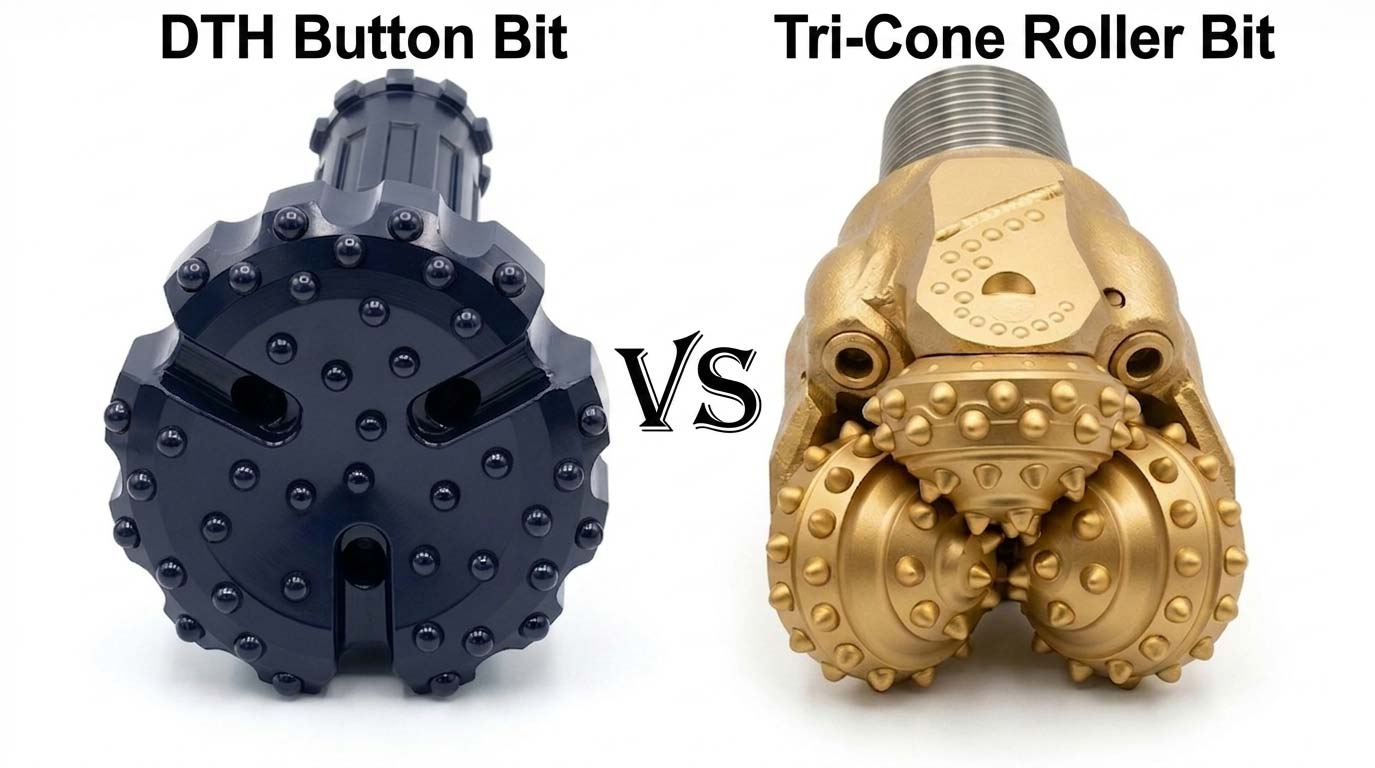
DTH (Down-The-Hole) drilling and rotary drilling are fundamentally different rock-breaking methods, and choosing the wrong one wastes fuel, destroys bits, and kills project timelines. DTH drilling delivers percussive energy directly at the rock face through a pneumatic down-the-hole hammer positioned behind the bit. Rotary drilling crushes rock by applying torque and downward force from the surface through the drill string.
MSD is an ISO 9001 certified rock drilling tools manufacturer with 23+ years of export experience, supplying DTH hammers, bits, drill pipes, and casing systems to 1,000+ drilling contractors across 40+ countries. This guide draws on MSD's field data to give you a quantified, objective comparison — so you can match the right drilling method to your specific rock formation, hole diameter, and project requirements.
How DTH and Rotary Drilling Actually Work
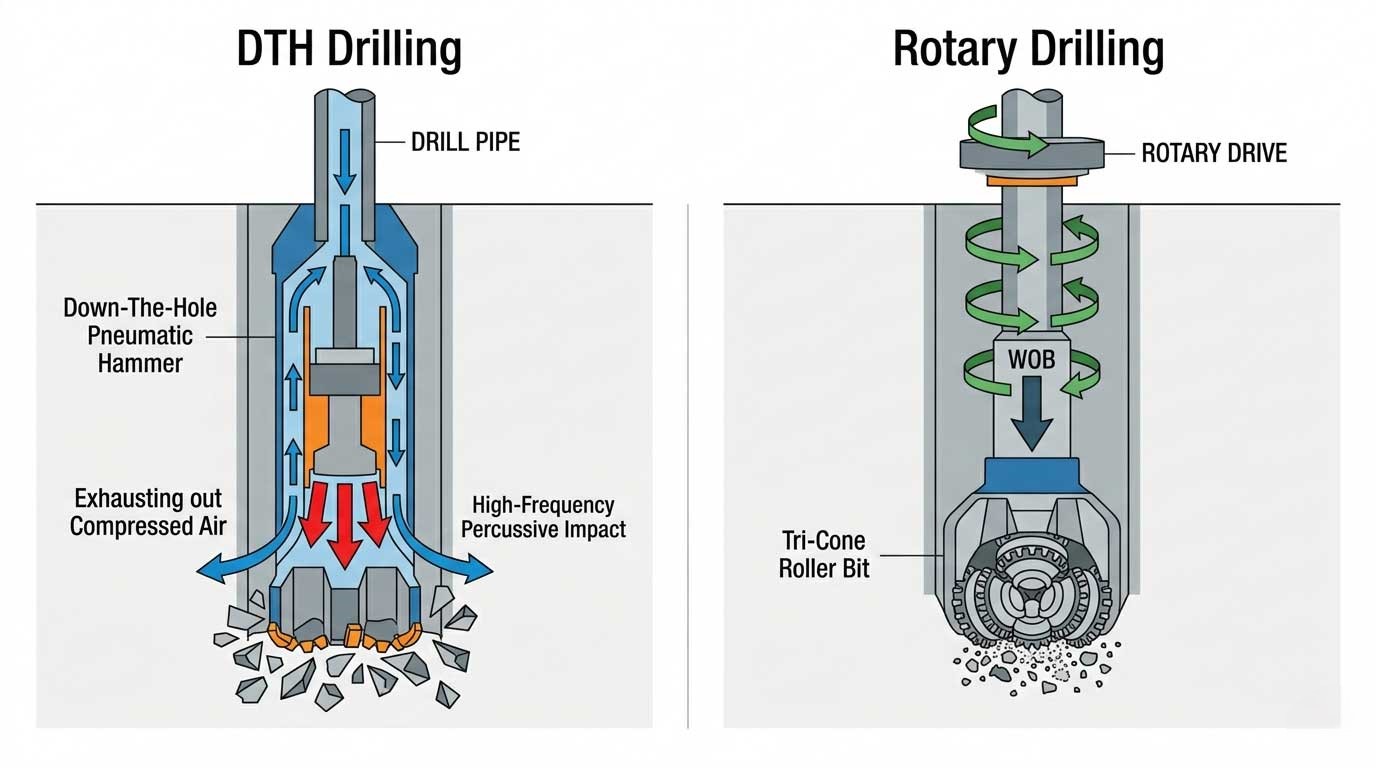
The mechanical difference between DTH and rotary drilling comes down to one question: where does the rock-breaking energy originate? DTH generates impact energy at the bottom of the hole. Rotary generates rotational force at the surface. That single distinction drives every performance difference between the two methods. DTH and rotary are two of several rock drilling techniques used across the industry. For a broader drilling methods overview including top hammer, auger, and cable tool techniques, see our complete methods guide.
DTH Drilling Mechanism — Hammer at the Bit Face
DTH drilling uses a pneumatic hammer positioned directly behind the DTH drill bit at the bottom of the borehole. Compressed air drives a piston inside the hammer, which strikes the bit at frequencies of 1,500–3,000 blows per minute. The bit transmits that percussive energy directly into the rock face while the drill string above rotates slowly to index the bit between strikes.
The critical engineering principle here is energy transfer efficiency. Because the hammer sits immediately behind the bit, virtually zero percussive energy is lost through the drill string — regardless of hole depth. A DTH hammer delivers the same impact force at 10 meters as it does at 200 meters. This is the fundamental physics that makes DTH drilling uniquely effective in deep, hard-rock applications.
The bit connects to the hammer through a splined shank and retaining ring system, which transmits rotational torque while absorbing repeated high-frequency impacts. MSD DTH hammers operate across pressure ranges from 12 bar to 25 bar depending on the series, with higher pressures delivering greater energy per blow for harder formations. For a complete DTH drilling guide covering air requirements by hole size, drilling parameters, and system selection from scratch, see our dedicated beginner's resource.
Rotary Drilling Mechanism — Rotation and Weight on Bit
Rotary drilling breaks rock through a completely different mechanism: a rotary head at the surface generates torque, which is transmitted down the drill string to a tri-cone or PDC (Polycrystalline Diamond Compact) bit. Simultaneously, the weight of the drill string (WOB — Weight on Bit) presses the bit against the rock face. Rock is broken through crushing, grinding, and shearing action rather than percussive impact.
The fundamental limitation of rotary drilling is energy attenuation. As hole depth increases, more energy is lost to drill string flex, friction against the borehole wall, and vibration. At shallow depths in soft formations, this energy loss is negligible. In deep holes through hard rock, rotary drilling loses a significant percentage of surface-generated energy before it ever reaches the bit face — which is precisely why penetration rate drops and bit wear accelerates in those conditions.
Cuttings removal in rotary drilling relies on circulating drilling fluid (mud) or compressed air to flush material up the annulus. DTH drilling uses the hammer's exhaust air to flush cuttings directly from the bit face, providing inherently efficient hole cleaning.
DTH vs Rotary Drilling — Head-to-Head Performance Comparison
The table below compares DTH and rotary drilling across 10 parameters that determine real-world drilling performance, operational efficiency, and tool longevity on the job site.
Comparison Table — 10 Critical Parameters
| Parameter | DTH Drilling | Rotary Drilling |
|---|---|---|
| Energy transfer mechanism | Direct — hammer at bit face | Indirect — surface to bit via drill string |
| Optimal rock hardness | Medium-hard to extremely hard (100–300+ MPa UCS) | Soft to medium (< 100 MPa UCS) |
| Hole diameter range | 90–1,000 mm | 150–2,000 mm+ |
| Typical depth range | 15–60 m (bench drilling); up to 300 m+ (production wells) | Virtually unlimited with proper rig configuration |
| Penetration rate in hard rock (>150 MPa UCS) | Typically 0.3–0.8 m/min depending on formation and hammer pressure | Drops significantly below 0.2 m/min; accelerating bit wear |
| Hole deviation | Low — typically < 1–2% of total hole depth | Higher in hard, fractured, or interbedded formations |
| Bit service life in granite (>180 MPa) | 300–800+ drilling meters per bit (depending on diameter and button configuration) | Tri-cone bits: typically 100–300 m in equivalent formations |
| Air/power requirement | High-pressure compressor (17–25 bar typical for production DTH) | High-torque rotary head + hydraulic pulldown; lower air pressure but higher torque demand |
| Surface noise and vibration | Lower — impact energy is generated at depth | Higher — rotational energy originates at surface |
| Cuttings removal | Efficient — compressed exhaust air flushes directly from bit face | Depends on mud/air circulation system; less efficient in dry hard rock |
What the Table Tells You
DTH drilling dominates in three specific scenarios: hard rock (UCS above 100 MPa), holes requiring tight deviation tolerances, and applications where consistent penetration rate at depth is critical. Rotary drilling wins in soft formations, very large diameter holes (above 311 mm in soft ground), and situations requiring extreme depth beyond 300 meters in sedimentary geology.
The crossover point between the two methods is not arbitrary. It follows a predictable engineering relationship between rock hardness, hole depth, and required diameter.
Rule of Thumb: If the rock UCS exceeds 100 MPa and the target hole depth is beyond 20 meters, DTH drilling will almost always deliver a lower per-meter drilling expenditure than rotary — the harder and deeper, the wider the DTH advantage.
The reason is physics. DTH maintains constant energy delivery regardless of depth, while rotary loses energy proportionally to drill string length. In a 50-meter hole through 200 MPa granite, a DTH hammer delivers the same blow energy at the bottom as at 5 meters. A rotary rig at that same depth may lose 30–40% of its surface-generated energy to string friction and flex.
Rock Formation Suitability — Where Each Method Excels
Rock formation hardness is the single most important variable when choosing between DTH and rotary drilling. The Uniaxial Compressive Strength (UCS) of the target formation determines which energy transfer mechanism — percussive or rotational — breaks rock more efficiently.
Hard and Abrasive Rock (Granite, Gneiss, Basalt — >150 MPa)
DTH drilling is the clear winner in hard and abrasive formations. Direct percussive energy at the bit face fractures high-UCS rock far more efficiently than the crushing action of rotary tri-cone bits. In granite with UCS values exceeding 180 MPa, DTH penetration rates remain stable while rotary rates decline sharply as bit wear accelerates.
MSD DTH button bits designed for hard rock use spherical button configurations. Spherical buttons distribute impact force evenly across the button surface, resisting fracture and maintaining gauge diameter in highly abrasive formations. MSD's cold-press interference fit process secures each tungsten carbide button with a sub-0.05% button loss rate — a critical advantage in DTH drilling where each button endures thousands of direct percussive impacts per minute.
Field Data: "Iron Ore Mining, Russia"
MSD QL60 DTH bits achieved 340 drilling meters per bit in Russian iron ore mining operations, drilling through formations with UCS values exceeding 180 MPa. The cold-press interference fit button retention maintained consistent gauge diameter throughout the full bit service life, eliminating premature gauge loss that typically forces early bit changes.
Soft to Medium Formations (Clay, Sandstone, Limestone —<80 MPa)
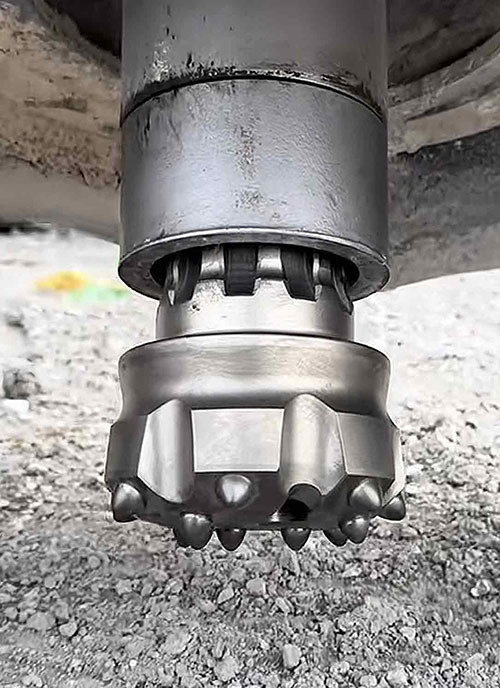
Rotary drilling is generally more efficient in soft to medium formations. Low-UCS rock yields readily to the crushing and shearing action of tri-cone and PDC bits without requiring percussive impact. Rotary rigs achieve high penetration rates in these conditions with lower air pressure requirements than DTH systems.
DTH drilling can still work in soft formations, but the method is over-engineered for the application. The percussive energy that makes DTH dominant in granite provides diminishing returns in sandstone or clay, where rotational force alone breaks rock effectively. Using DTH in soft ground also risks over-fragmentation of cuttings, which can impede flushing efficiency.
Mixed or Fractured Geology
Fractured and interbedded formations present a unique challenge where DTH drilling's accuracy advantage becomes decisive. Rotary bits tend to wander when they encounter discontinuities — fracture planes, voids, or abrupt transitions between hard and soft layers deflect the bit off its intended path. DTH bits, guided by the rigid hammer body directly behind them, maintain straighter hole trajectories through inconsistent geology.
For drilling through unstable overburden layers above bedrock, MSD supplies eccentric casing systems (ODEX) that simultaneously drill and case the hole. ODEX systems prevent borehole collapse in unconsolidated material while allowing the DTH bit to advance into competent rock below.
Application Guide — DTH vs Rotary Across 5 Industries
No single drilling method is universally superior. The right choice depends on the specific application, target formation, required hole geometry, and site constraints. Below is a field-tested breakdown across five major drilling industries.
Mining (Blast Hole Drilling)
DTH drilling dominates blast hole drilling in hard-rock mines. Typical blast hole diameters range from 115 mm to 254 mm at depths of 12–30 meters per bench. Hole accuracy is critical in mining because blast pattern geometry directly controls fragmentation quality, wall stability, and explosive consumption.
Rotary drilling is used in mining for very large diameter production holes (above 311 mm) in softer overburden or for pre-split holes where high-torque, low-frequency rotation is preferred. Many large open-pit operations use both methods on the same site — rotary for overburden removal and DTH for bedrock benches.
Quarrying
DTH is the standard drilling method for aggregate and dimension stone quarries operating in hard rock (granite, basalt, gneiss). Typical quarry blast holes range from 76 mm to 152 mm diameter at depths of 10–25 meters. DTH's low hole deviation ensures precise blast patterns that maximize yield and minimize overbreak.
Rotary drilling finds its place in soft limestone and sandstone quarries where the rock UCS is below 80 MPa. In these formations, rotary tri-cone bits achieve high penetration rates with simpler compressor requirements than DTH systems.
Water Well Drilling
DTH drilling is the preferred method for water well drilling in hard-rock aquifers — particularly crystalline basement formations common across Sub-Saharan Africa, South America, and parts of Southeast Asia. Typical water well diameters range from 152 mm to 311 mm at depths of 30–300 meters. DTH's consistent penetration rate at depth makes it far more productive than rotary in these conditions.
Mud rotary drilling is preferred for deep sedimentary water wells in soft formations (alluvial deposits, sandstone aquifers) where borehole stability requires continuous mud circulation. MSD manufactures DTH hammers compatible with all major water well rig configurations, covering DHD, MISSION, QL, SD, COP, and NUMA series.
Construction (Foundation, Piling, Anchoring)
DTH drilling is the method of choice for micropiles, rock anchors, and cased holes in urban construction projects encountering hard rock. Hole diameters typically range from 90 mm to 254 mm at depths of 5–30 meters. DTH's low surface vibration is a significant advantage in urban environments where structural damage to adjacent buildings must be avoided.
For cased drilling through mixed ground conditions — loose fill over fractured rock, for example — MSD's Symmetrix concentric casing system provides simultaneous drilling and casing installation. Rotary drilling (CFA and bored piling) remains the standard for large-diameter foundation piles in cohesive soils and soft clay.
Geothermal Drilling
DTH drilling is effective for shallow-to-medium geothermal wells (50–300 meters) in crystalline rock formations. Geothermal borehole fields in Scandinavia, Iceland, and East Africa commonly use DTH methods for closed-loop heat exchange wells drilled through granite and basalt at diameters of 152–254 mm.
Rotary drilling is the standard for deep geothermal wells exceeding 500 meters in sedimentary basins, where high temperatures, extreme depths, and the need for continuous mud circulation favor rotary rig configurations. In many geothermal projects, DTH handles the upper crystalline section while rotary completes the deeper sedimentary interval.
Application Comparison Matrix
| Application | Recommended Method — Hard Rock | Recommended Method — Soft Ground | Typical Hole Diameter | Typical Depth |
|---|---|---|---|---|
| Mining (blast holes) | DTH | Rotary | 115–254 mm | 12–30 m |
| Quarrying | DTH | Rotary | 76–152 mm | 10–25 m |
| Water Well | DTH | Mud Rotary | 152–311 mm | 30–300 m |
| Construction | DTH (with casing) | Rotary (CFA/bored) | 90–254 mm | 5–30 m |
| Geothermal | DTH | Rotary | 152–254 mm | 50–300 m+ |
For a comprehensive guide to borehole drilling applications — including equipment checklists, casing solutions, and completion procedures by industry — see our dedicated borehole drilling resource.
How to Decide — A Practical Decision Framework
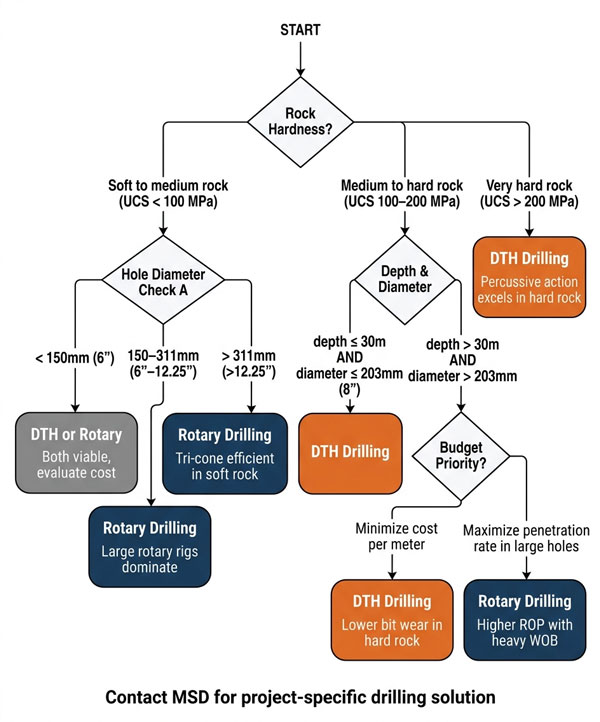
Choosing between DTH and rotary drilling does not require guesswork. Four technical questions, answered in sequence, will point you toward the right method for virtually any project.
The 4-Question Decision Tree
Question 1: What is the rock UCS? If the target formation exceeds 100 MPa — lean strongly toward DTH. Below 80 MPa — lean toward rotary. Between 80–100 MPa is the crossover zone where either method can work, and the remaining three questions determine the winner.
Question 2: What hole diameter is required? DTH's sweet spot is 90–311 mm. Above 311 mm in soft rock, rotary is typically more practical. For large-diameter DTH drilling (up to 1,000 mm), specialized high-pressure hammers and cluster bits are available but require significantly higher compressor capacity.
Question 3: What is the target depth? Beyond 20 meters in hard rock, DTH's advantage grows with every additional meter — because energy delivery remains constant while rotary efficiency degrades. For shallow holes under 10 meters in soft ground, rotary is faster and simpler to set up.
Question 4: Is hole accuracy critical? If the project demands tight deviation tolerances — blast pattern optimization in mining, vertical water wells, or structural piling in urban areas — DTH delivers consistently straighter holes. If deviation tolerance is flexible (e.g., preliminary site investigation), either method works.
When You Need Both
Many large-scale drilling operations deploy both methods on the same project site. A typical open-pit mine might use rotary rigs to drill through 15 meters of soft overburden, then switch to DTH for 20 meters of hard bedrock beneath. Water well projects in layered geology follow the same logic — mud rotary through the upper sedimentary section, DTH through the crystalline basement.
MSD manufactures DTH hammers, bits, and drilling pipes supporting both DTH and rotary drilling operations, giving drilling contractors the flexibility to deploy the right method for each section of the borehole. If your project involves shallow hard-rock holes where top hammer is also a contender, see our DTH vs top hammer drilling comparison for a detailed performance and expenditure analysis in the overlap zone.
MSD DTH Tooling — Built for the Applications Where DTH Wins
MSD manufactures the complete DTH drill string: hammers, bits, and drill pipes. In our 23+ years of manufacturing and exporting rock drilling tools, MSD has supplied DTH tooling to hard-rock drilling projects across mining, quarrying, water well, construction, and geothermal applications in 40+ countries.
DTH Hammer and Bit Range
MSD DTH hammer series are compatible with all major industry series — DHD, MISSION, QL, SD, COP, and NUMA — covering hole diameters from 90 mm to 1,000 mm. Operating pressures range from 12 bar for light-duty water well applications to 25 bar for high-energy production drilling in extremely hard formations.
Every MSD DTH bit uses cold-press interference fit button retention. This is not brazing. Cold pressing creates a mechanical interference bond between the tungsten carbide button and the steel bit body that withstands the repeated high-frequency percussive impacts inherent to DTH drilling.
Why Button Retention Matters in DTH
In DTH drilling, every button on the bit face endures direct percussive impact at frequencies of 1,500–3,000 blows per minute. Button retention is the single most common failure mode in DTH bits — if a button loosens or ejects, the exposed steel body erodes rapidly, and the bit must be replaced regardless of remaining carbide life on the other buttons.
MSD's cold-press interference fit achieves a sub-0.05% button loss rate across production. This means that in a standard 6-inch DTH bit carrying 18 buttons, the statistical probability of losing even one button before the carbide wears out naturally is extremely low. Based on our experience supplying 1,000+ drilling contractors, button retention — not carbide grade — is the factor that most frequently determines whether a DTH bit reaches its full potential service life or gets pulled prematurely.
Rule of Thumb: When evaluating DTH bit suppliers, ask for the button retention method and the field-verified button loss rate. Cold-press interference fit with documented loss rates below 0.1% is the industry benchmark for production-grade DTH bits. For application-specific guidance on DTH hammer and bit selection — organized by drilling scenario, formation type, and hole specification — see our complete tool selection guide.
MSD supplies complete DTH drill pipe strings to match all standard DTH hammer thread connections. Heat-treated alloy steel construction provides the fatigue resistance needed for deep-hole applications and extended service intervals in production drilling.
Frequently Asked Questions
Q: What is the difference between rotary and DTH drilling?
A: Rotary drilling breaks rock by applying torque and weight from the surface through the drill string. DTH drilling breaks rock by delivering percussive hammer blows directly at the bit face at the bottom of the hole. DTH maintains consistent energy delivery regardless of depth, while rotary loses energy through the drill string as depth increases. DTH excels in hard rock above 100 MPa UCS; rotary is more efficient in soft formations below 80 MPa.
Q: What does DTH mean in drilling?
A: DTH stands for Down-The-Hole. DTH drilling is a percussion drilling method where the pneumatic hammer operates at the bottom of the borehole, directly behind the drill bit. Compressed air drives a piston inside the hammer that strikes the bit at 1,500–3,000 blows per minute. The drill string above rotates slowly to index the bit between impacts.
Q: What are the three main types of drilling methods?
A: The three primary rock drilling methods are top hammer, DTH (Down-The-Hole), and rotary. Top hammer drilling generates percussive energy at the surface and transmits it through the drill string — effective for shallow holes in hard rock. DTH places the hammer at the bit face for deep hard-rock applications. Rotary uses rotation and weight to crush rock, best suited for soft formations.
Q: What is the DTH method of drilling?
A: DTH drilling positions a pneumatic hammer directly behind the bit at the bottom of the borehole. Compressed air (typically 17–25 bar for production drilling) drives a piston that strikes the bit thousands of times per minute. The bit transmits percussive energy directly into the rock face while the drill string rotates slowly from the surface. Exhaust air flushes cuttings up the annulus between the drill string and borehole wall.
Q: Can DTH and rotary drilling be used on the same project?
A: Yes. Many large drilling operations use both methods on the same site. A common approach in open-pit mining is to drill overburden with a rotary rig, then switch to DTH for the hard-rock bench below. Water well projects in layered geology follow the same logic — mud rotary through soft sedimentary layers, DTH through the crystalline basement aquifer.
Q: What DTH hammer series does MSD supply?
A: MSD manufactures DTH hammers compatible with DHD, MISSION, QL, SD, COP, and NUMA series, covering hole diameters from 90 mm to 1,000 mm. Operating pressures range from 12 bar to 25 bar across the full product line. All MSD DTH bits use cold-press interference fit button retention with a documented sub-0.05% button loss rate.
Technical content reviewed by MSD Engineering Team. | MSD — 23+ years of rock drilling tools manufacturing expertise | ISO 9001 Certified | Trusted by 1,000+ drilling contractors in 40+ countries