

DTH vs Top Hammer Drilling: Performance Data & Selection Guide
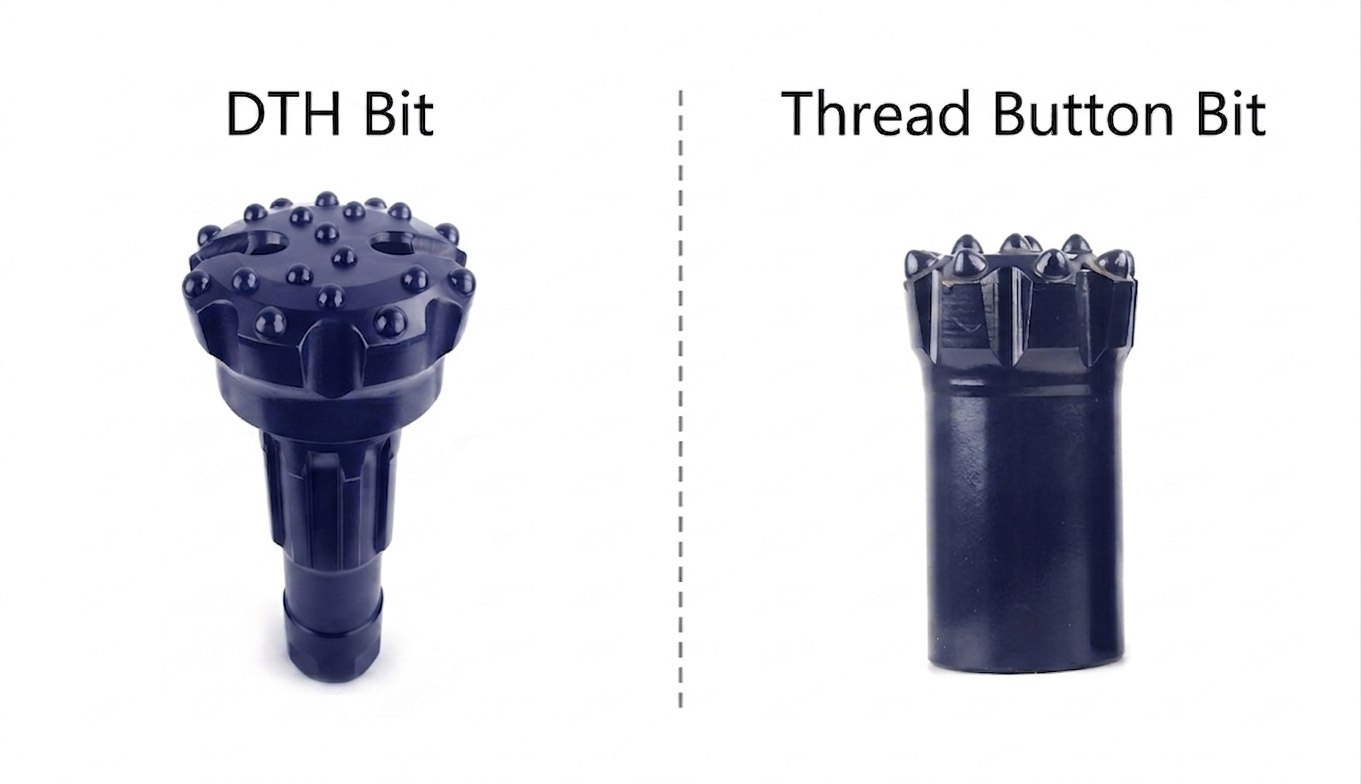
Choosing between DTH and top hammer drilling directly affects penetration rate, consumable life, and total expenditure per drilled meter on every project. These two percussion drilling methods share a common principle — striking rock with a tungsten carbide button bit — but differ fundamentally in where the hammer delivers its blow. That single mechanical difference cascades into measurable performance gaps across depth, diameter, hole accuracy, and operating expenditure.
MSD is an ISO 9001-certified rock drilling tools manufacturer with 23+ years of export experience, supplies both DTH and top hammer systems to 1,000+ drilling contractors in 40+ countries. This article breaks down the engineering mechanisms of each method, compares their performance with quantified data, and provides a structured decision framework so you can select the right system for your specific depth, diameter, and rock formation.
How DTH Drilling Works — Mechanism and Components
The DTH Impact Mechanism — Why the Hammer Goes Downhole
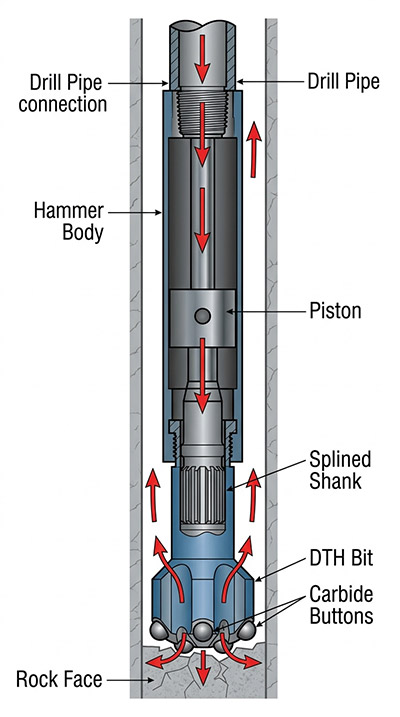
Down-The-Hole (DTH) drilling is a percussion drilling method where a pneumatic hammer operates at the bottom of the hole, directly behind the drill bit. Compressed air — typically at 10–25 bar working pressure — drives a piston inside the hammer body. That piston strikes the rear face of the bit in rapid, repeated blows, fracturing rock at the hole bottom with each impact cycle.
The critical engineering advantage is location. Because the DTH hammer travels downhole with the bit, impact energy transfers directly from piston to bit face regardless of hole depth. A 30-meter hole receives the same strike energy as a 3-meter hole. MSD manufactures DTH hammers across all major global series — DHD, MISSION, QL, SD, COP, and NUMA — covering bit diameters from 90 mm to 1,000 mm for applications ranging from water well drilling to large-scale open-pit mining. For a comprehensive introduction to the fundamentals of DTH drilling — including air requirements, operating parameters, and common beginner mistakes — see our dedicated beginner's guide.
DTH System Components — Hammer, Bit, and Drill Pipe
A complete DTH drill string consists of four primary components assembled in sequence: the drill rig's rotation head, DTH drill pipes, the DTH drilling hammer, and the DTH rock bit at the very bottom.
The DTH bit connects to the hammer through a splined shank and retaining ring system — not a threaded connection. This splined interface transmits rotational torque from the drill string while allowing the bit to absorb direct axial impact from the piston without thread fatigue. The DTH drill pipes above the hammer serve only to transmit rotation and feed force; they carry no percussive energy. This separation of functions is what makes DTH drilling depth-independent in terms of energy delivery. For a detailed engineering breakdown of how the DTH hammer percussion cycle works — including piston dynamics, air distribution, and exhaust timing — see our technical guide.
How Top Hammer Drilling Works — Mechanism and Components
The Top Hammer Impact Mechanism — Percussion at the Surface
Top Hammer Drilling (THD) is a percussion drilling method where a hydraulic or pneumatic rock drill, mounted on the drilling rig at the surface, delivers impact blows to the top of the drill string. The percussive energy generated at the surface must then travel through the entire length of the drill string — passing through multiple coupled drill rod joints — before reaching the bit at the hole bottom.
This means the hammer never enters the hole. The rock drill strikes a shank adapter, which converts impact energy into a stress wave. That stress wave propagates down through each successive drill rod, through each threaded coupling, and finally into the button bit. Every interface the wave crosses introduces energy reflection and loss.
Top Hammer System Components — Rock Drill, Shank Adapter, Rods, and Bit
A top hammer drill string consists of four components in series: the rock drill, a shank adapter, coupled drill rods (also called extension rods), and a threaded button bit at the bottom.
The shank adapter is the first component to receive the percussive blow. MSD manufactures shank adapters and drill rods across the full range of standard thread types — R25, R28, R32, R38, T38, T45, T51, ST58, and ST68. Threaded button bits thread directly onto the bottom rod. These may feature conical (tapered), ballistic, or spherical button profiles depending on the rock type. Every threaded coupling between rods is a mechanical junction where stress wave impedance changes — and where energy is partially reflected back toward the surface rather than continuing toward the bit.
DTH vs Top Hammer — Side-by-Side Performance Comparison
Energy Transfer Efficiency and Depth Performance
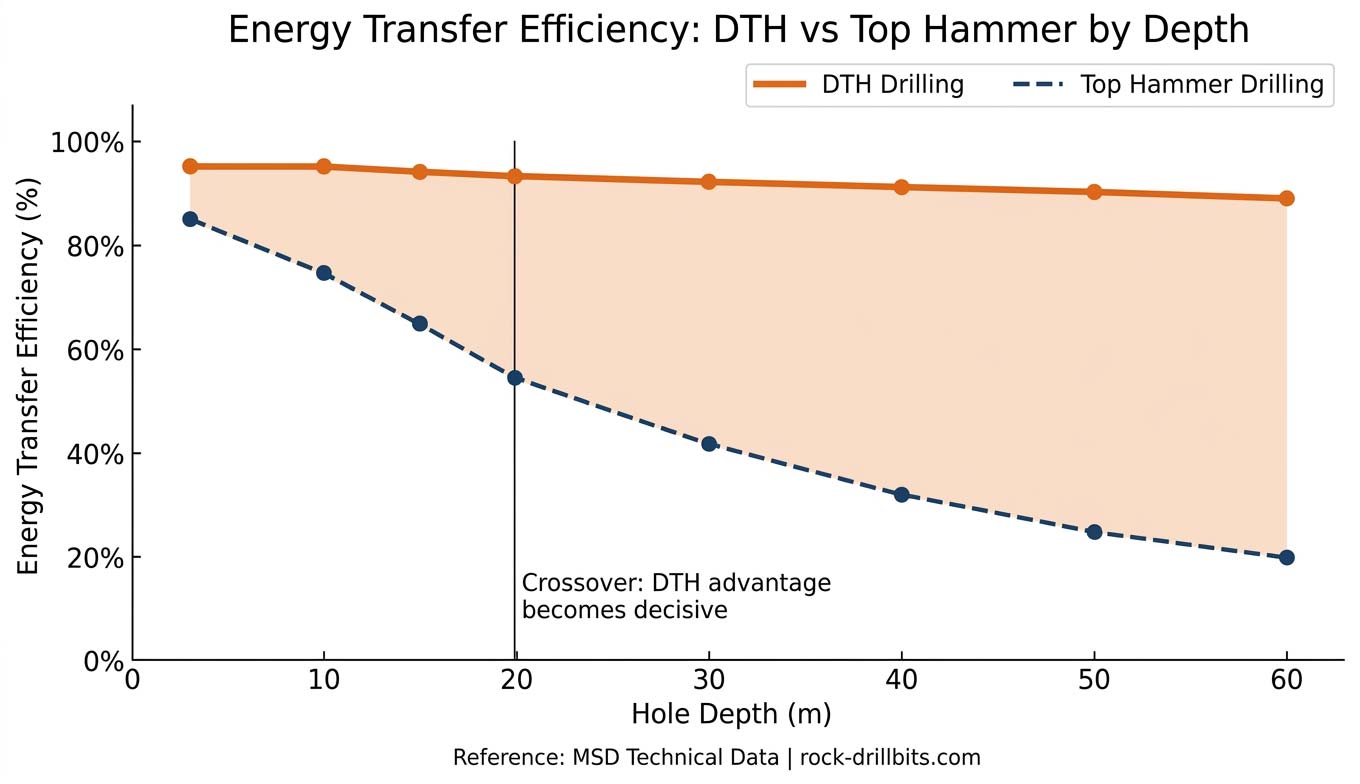
DTH drilling maintains greater than 95% energy transfer from piston to bit face at any hole depth, while top hammer drilling loses a measurable percentage of impact energy at every threaded rod joint in the drill string. This is the single most important engineering distinction between the two methods, and it governs nearly every downstream performance difference.
Rule of Thumb: In top hammer drilling, approximately 10–15% of impact energy is lost at each threaded rod joint due to stress wave reflection at the impedance mismatch. At 20 m depth with 6 rod joints, only roughly 40–50% of the surface-generated energy reaches the bit face. DTH drilling delivers >95% of piston energy directly to the bit at any depth.
The physics behind this are straightforward. A stress wave traveling through a solid steel rod encounters a change in cross-sectional area and material contact at every threaded coupling. Part of the wave reflects backward; part transmits forward. Over multiple joints, these losses compound. DTH eliminates this problem entirely because the hammer sits directly behind the bit — zero joints between piston and cutting face.
In practical terms, a top hammer system drilling at 5 m depth performs nearly as efficiently as DTH. At 20 m, the top hammer system delivers roughly half the energy. At 30 m or beyond, top hammer penetration rate drops so severely that most operations switch to DTH.
Hole Diameter Range and Accuracy
Top hammer drilling excels in small-diameter holes, typically 32–127 mm, where the lighter drill string and higher rotation speed produce fast, accurate results. DTH drilling is the standard for medium to large diameters — 90–1,000 mm — where the stabilized hammer-bit assembly at the hole bottom naturally resists deviation.
The crossover zone falls between 89 mm and 127 mm diameter. In this range, both methods are technically viable, and the decision depends on depth and rock type. For holes shallower than 15 m in this diameter range, top hammer often wins on cycle time. For holes deeper than 15 m, DTH delivers straighter holes with more consistent penetration because the heavy hammer body acts as a stabilizer, keeping the bit aligned.
Penetration Rate by Rock Type
In soft-to-medium rock formations below 100 MPa UCS (Unconfined Compressive Strength), top hammer drilling can match or exceed DTH penetration rates in shallow holes. The higher rotation speed and rapid impact frequency of hydraulic rock drills give top hammer an edge when the rock fractures easily and depth is limited.
In hard rock formations exceeding 150 MPa UCS, DTH maintains consistent penetration rates regardless of depth. Top hammer systems suffer doubly in hard rock at depth: reduced energy delivery compounds with increased reflected stress waves that accelerate thread wear on rod couplings. MSD's field experience across 40+ countries confirms that drilling contractors consistently report switching from top hammer to DTH when formations exceed 120–150 MPa and hole depths exceed 15 m.
In highly abrasive formations — such as quartzite or abrasive granite — both methods face accelerated button wear. However, DTH bits are generally easier to regrind in the field because the larger button diameters and face geometry allow re-sharpening with standard grinding cups.
Noise, Vibration, and Operator Environment
DTH drilling produces significantly lower surface noise and vibration because the hammer operates underground, with rock and the drill string absorbing most of the acoustic energy. Top hammer drilling concentrates all percussive impact at the surface, generating higher noise levels that increasingly face regulatory restrictions in urban construction zones and environmentally sensitive areas.
For projects near residential areas, hospitals, or protected habitats, DTH drilling's reduced surface noise profile can be a decisive factor — sometimes more important than pure drilling efficiency.
Performance Comparison Table
| Dimension | DTH Drilling | Top Hammer Drilling |
|---|---|---|
| Hammer location | Downhole, directly behind the bit | Surface-mounted on rig |
| Energy transfer at 20 m depth | >95% | ~40–50% (with 6 rod joints) |
| Optimal hole diameter | 90–1,000 mm | 32–127 mm |
| Optimal depth range | 15–60 m+ (no degradation) | 1–20 m (up to 40 m with severe losses) |
| Hole straightness (deep holes) | Excellent — hammer stabilizes the bit | Degrades with depth |
| Penetration in hard rock (>150 MPa) | Consistent at any depth | Decreases significantly with depth |
| Surface noise level | Low — hammer is underground | High — hammer is at surface |
| Bit-to-hammer connection | Splined shank and retaining ring | Threaded (R25–ST68) |
| Air/hydraulic requirement | Higher CFM compressor required | Lower compressor requirement |
Component Quality Matters — Why the Drilling Method Is Only Half the Equation
Button Retention — The Hidden Performance Differentiator
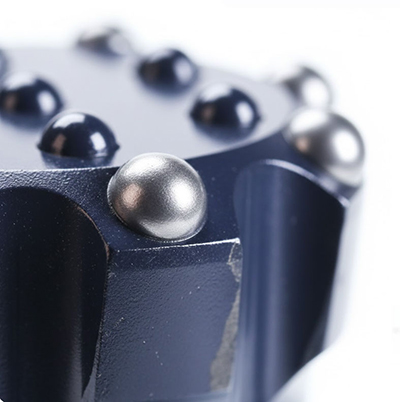
Regardless of whether a project uses DTH or top hammer, bit quality determines real-world performance more than most operators realize. The most common field failure in both DTH bits and threaded button bits is premature button loss — a single lost tungsten carbide button causes asymmetric wear patterns, hole deviation, and premature bit retirement.
MSD uses cold-press interference fit technology for button installation across both DTH and top hammer bit product lines. Cold pressing forces the tungsten carbide button into a precision-machined socket with controlled interference — the socket diameter is fractionally smaller than the button diameter. This mechanical grip holds the button in place through friction alone, without brazing or adhesive. MSD's manufacturing process achieves a sub-0.05% button loss rate across production, verified through batch testing.
Field Data: "Button Retention Testing, MSD Production Line"
MSD's cold-press interference fit process produces a button retention rate exceeding 99.95% across all bit types. In our 23+ years of manufacturing and supplying 1,000+ drilling contractors globally, premature button loss remains the single most-reported cause of bit failure from competitors — and the issue MSD's process is specifically engineered to prevent.
Carbide Grade Selection Across Both Systems
MSD selects tungsten carbide grades matched to each application's specific demands. Higher cobalt content (typically 10–12%) provides greater impact toughness for fractured, broken, or heavily jointed rock where buttons absorb irregular impact loads. Lower cobalt content (6–8% or lower) produces harder, more abrasion-resistant buttons suited to massive, homogeneous granite or gneiss where abrasive wear matters more than impact toughness.
This grade selection applies equally to DTH button bits and tapered button bits. A tapered button bit drilling in fractured limestone needs a different carbide grade than a DTH bit drilling in solid quartzite — and MSD configures both from the same metallurgical expertise. For a complete application-by-application guide to matching the right DTH hammer and bit to your specific drilling scenario, see our DTH tool selection guide.
Expenditure Per Meter — The Real Comparison That Matters
Initial Investment vs. Operating Expenditure
DTH systems require a larger air compressor — typically 15–25 bar and 300–900 CFM depending on hammer size — which represents a higher initial capital outlay compared to top hammer setups. However, DTH often delivers lower total expenditure per drilled meter in deep, hard-rock applications because the consistent energy transfer extends bit life and maintains penetration rate.
Top hammer systems require smaller compressors or use the rig's built-in hydraulic power, reducing upfront equipment expenditure. But in deep holes, the accelerated thread wear on rod couplings, the fatigue cracking in extension drill rods, and the faster bit wear from reduced energy delivery all increase consumable replacement frequency. These recurring consumable expenditures can exceed the savings on compressor investment within a single project season.
A Real-World Expenditure-Per-Meter Scenario
To illustrate the expenditure dynamics, consider a typical quarry bench drilling scenario where both methods are technically viable — the overlap zone.
Field Data: "Quarry Bench Drilling — Granite Formation, 100–140 MPa UCS"
Hole specification: 115 mm diameter, 18 m depth. Top hammer system (T45 thread button bit + 4 coupled drill rods): penetration rate dropped from 0.8 m/min at 5 m depth to 0.45 m/min at 18 m depth; bit life averaged 350 drilled meters; rod coupling replacement required every 1,200 m. DTH system (4" DHD hammer + 115 mm DTH button bit): penetration rate remained stable at 0.7 m/min from surface to 18 m; bit life averaged 550 drilled meters; DTH pipe replacement interval exceeded 3,000 m.
In this scenario, the DTH system's higher compressor expenditure was offset by 57% longer bit life, stable cycle times, and reduced rod-string maintenance. For shallow benches under 10 m in the same formation, the top hammer system would typically be more economical due to faster setup time and lower air consumption.
How to Choose — DTH vs Top Hammer Decision Framework
Three Decision Criteria — Depth, Diameter, Rock Hardness
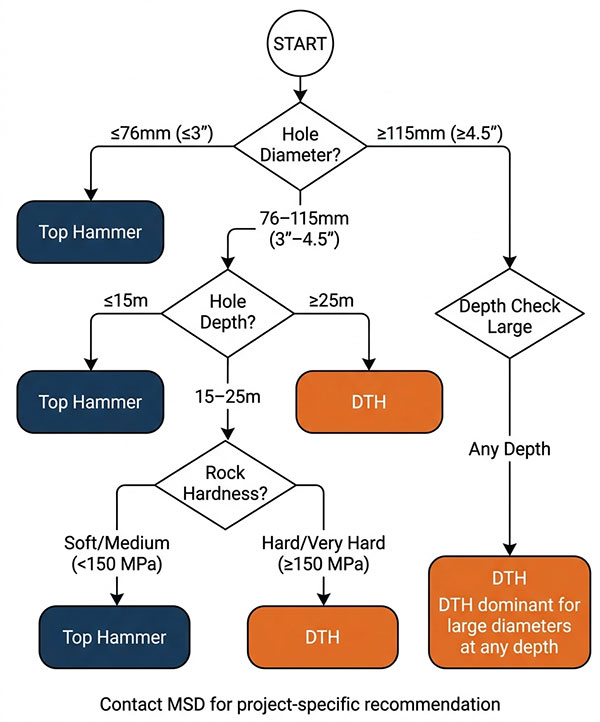
The choice between DTH and top hammer drilling depends on three primary variables: target hole depth, required hole diameter, and rock UCS. While secondary factors (noise restrictions, rig availability, compressor capacity) influence the final decision, these three parameters determine the technically optimal method in the vast majority of cases.
Decision logic based on MSD's field experience across 40+ countries:
Depth >15 m AND Diameter >89 mm AND Rock >100 MPa UCS → DTH is the clear choice. Energy transfer, hole straightness, and bit life all favor DTH in this parameter space.
Depth<15 m AND Diameter <89 mm AND Rock <150 MPa UCS→ Top hammer is typically more efficient and economical. Faster cycle times and lower compressor requirements give top hammer the edge.
Overlap zone (depth 10–20 m, diameter 89–127 mm, variable rock) → Evaluate expenditure per meter for both methods. Contact MSD engineers for a site-specific recommendation based on your formation data.
If your formation is soft or unconsolidated and neither DTH nor top hammer is the right fit, rotary methods may be more appropriate. See our DTH vs rotary drilling comparison for a detailed analysis of when rotary outperforms percussion methods.
When to Use Both Methods on the Same Project
Large mining and construction projects frequently deploy both DTH and top hammer systems on the same site. Open-pit mines commonly use DTH for deep production blast holes (15–25 m bench height, 115–165 mm diameter) while running top hammer rigs for shallow pre-split or trim blasting holes (6–12 m depth, 64–89 mm diameter).
MSD supplies complete tooling for both systems from a single source — DTH hammers, DTH bits, DTH drill pipes, plus top hammer drilling tools including thread button bits, taper button bits, drill rods, and shank adapters. Sourcing both systems from one ISO 9001-certified manufacturer simplifies procurement, ensures consistent quality across the entire drill fleet, and provides a single point of technical support. Drill More. Spend Less.
Application Guide — Best Method by Industry
Mining
Open-pit bench drilling is dominated by DTH. Production blast holes typically range from 115 mm to 254 mm diameter at bench heights of 10–25 m — parameters that place them firmly in DTH territory. The consistent penetration rate and hole straightness of DTH drilling directly improve blast fragmentation quality and reduce secondary breaking expenditure.
Underground development drilling, by contrast, favors top hammer tools. Tunnel face holes are typically 38–64 mm diameter and 3–5 m deep — well within top hammer's optimal range. The compact rig footprint and fast rod-handling of top hammer jumbos suit the confined underground environment.
Quarrying
Small aggregate quarries with shallow benches (under 8 m) often operate efficiently with top hammer systems. The lower compressor requirement and simpler drill string reduce operational complexity for smaller operations. Large-scale production quarries with bench heights exceeding 10 m and hole diameters above 89 mm benefit from DTH's depth-independent performance and longer bit life.
Water Well Drilling
Water well drilling is the industry standard for DTH. Boreholes typically require 150 mm to 311 mm diameter at depths ranging from 30 m to 300 m or more — parameters where top hammer is not viable. DTH maintains consistent penetration through the variable geological formations encountered in water well profiles: overburden, weathered rock, fractured zones, and competent bedrock.
In unconsolidated overburden layers, eccentric casing systems (ODEX) or concentric casing systems (Symmetrix) are paired with DTH hammers to simultaneously drill and case the borehole, preventing collapse in unstable formations.
Construction and Geothermal
Construction foundation drilling uses both methods depending on the specific task. Top hammer handles shallow anchor holes and rock bolting (typically 32–51 mm diameter, 2–6 m depth). DTH is preferred for piling, micropiles, and deep foundation work where diameters exceed 89 mm and depths exceed 10 m.
Geothermal borehole drilling relies almost exclusively on DTH. Closed-loop geothermal systems require boreholes of 115–152 mm diameter at depths of 50–300 m — far beyond top hammer's effective range. DTH's consistent penetration at depth keeps project timelines predictable across these demanding specifications. For a broader overview of all rock drilling methods compared — including rotary, auger, and cable tool techniques beyond the DTH and top hammer scope of this article — see our rock drilling fundamentals guide.
Frequently Asked Questions
Q: What is the difference between top hammer and DTH?
A: The fundamental difference is hammer location. In DTH drilling, the hammer operates at the hole bottom directly behind the bit, delivering >95% of impact energy at any depth. In top hammer drilling, the hammer sits at the surface and energy must travel through threaded drill rod joints — losing approximately 10–15% per joint. At 20 m depth with 6 joints, only 40–50% of surface energy reaches the bit.
Q: Can I use top hammer drilling for blast holes?
A: Top hammer can technically drill shallow blast holes (under 10 m, 64–89 mm diameter) in soft formations. However, production blast holes typically range from 115–254 mm at 15–25 m depth — specifications where DTH's consistent energy and hole accuracy provide significantly better fragmentation results. DTH is the industry standard for production blast-hole drilling.
Q: Can top hammer drilling reach the same depth as DTH?
A: Technically, top hammer drill strings can extend to 30–40 m using multiple coupled rods. However, energy transfer degrades severely beyond 15–20 m. Penetration rate drops, thread wear accelerates, and hole deviation increases. For depths beyond 20 m, DTH is the industry standard because it eliminates all depth-related energy losses.
Q: Does MSD manufacture tools for both DTH and top hammer systems?
A: Yes. MSD manufactures DTH hammers (DHD, MISSION, QL, SD, COP, NUMA series), DTH bits (90–1,000 mm), and DTH drill pipes. For top hammer systems, MSD produces thread button bits and taper button bits (R25–ST68), drill rods, and drill shank adapters. All products are manufactured under ISO 9001 certification at MSD's facility in Zhuzhou, China.
Q: How do I decide between DTH and top hammer for my project?
A: Evaluate three variables: hole depth, diameter, and rock UCS. If depth exceeds 15 m, diameter exceeds 89 mm, and rock exceeds 100 MPa — choose DTH. If depth is under 15 m, diameter under 89 mm, and rock under 150 MPa — top hammer is typically more efficient. For projects in the overlap zone, contact MSD engineers for a free technical consultation based on your specific formation data.
Technical content reviewed by MSD Engineering Team. | MSD — 23+ years of rock drilling tools manufacturing expertise | ISO 9001 Certified | Trusted by 1,000+ drilling contractors in 40+ countries