

Borehole Drilling: The Complete Guide to Methods, Equipment, and Applications
Borehole drilling is the engineered process of creating a narrow, cylindrical shaft into the earth's subsurface using specialized drilling equipment — and the method, tools, and completion strategy you select determine whether a project succeeds or fails. Every year, hundreds of thousands of boreholes are drilled worldwide for water supply, mining exploration, geothermal energy, and construction foundations. Yet the technical details that separate a productive borehole from a collapsed, abandoned one remain poorly understood outside the drilling industry.
This guide breaks down the complete borehole drilling process from an equipment engineering perspective. MSD is a rock drilling tools manufacturer with 23+ years of export experience serving 1,000+ drilling contractors in 40+ countries, provides the technical depth that generic overviews lack — covering actual tool specifications, drilling parameters by rock type, and casing solutions for unstable formations.
What Is Borehole Drilling?
Definition and Core Concept
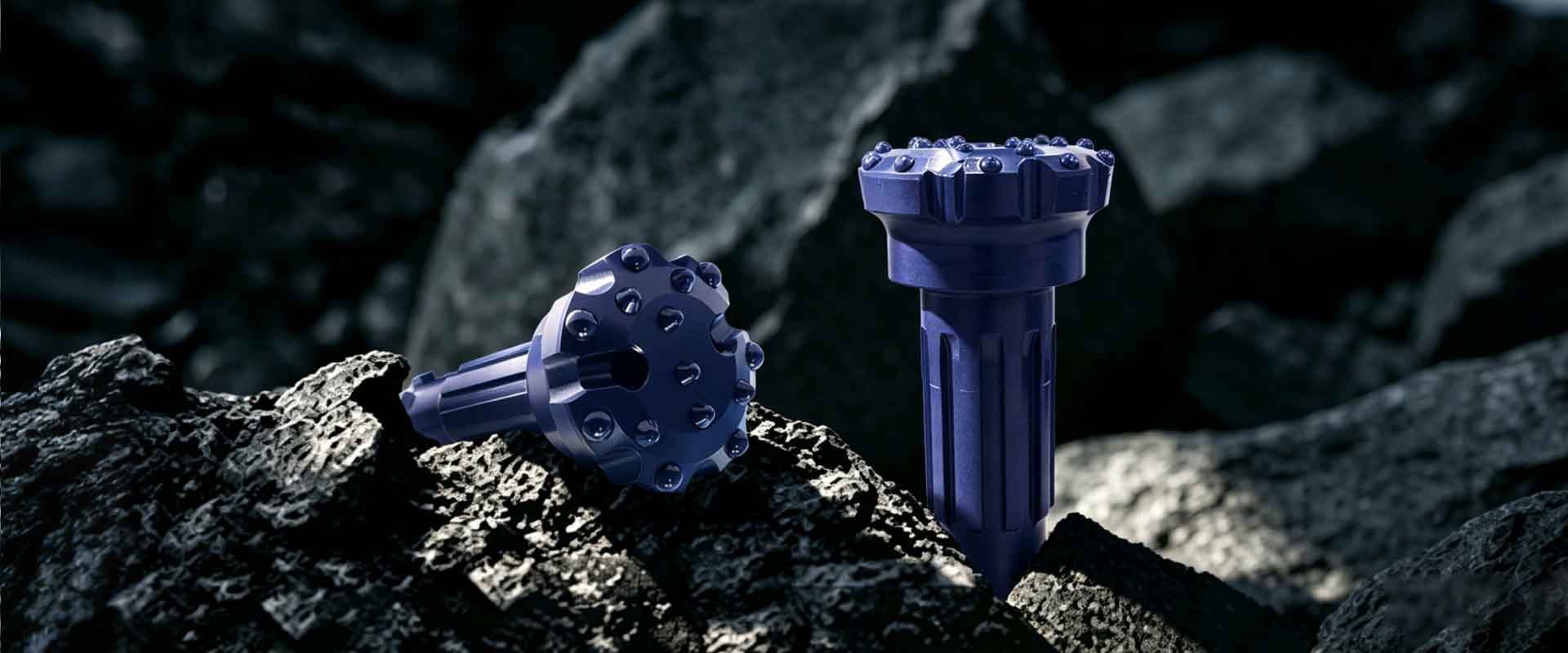
Borehole drilling is the mechanical process of boring a cylindrical hole — typically 90 mm to 1,000 mm in diameter — vertically or at an angle into the ground to access subsurface resources, install infrastructure, or collect geological data. The hole itself is called a borehole. The equipment used to create it ranges from compact portable rigs to truck-mounted machines weighing over 30 tonnes, but in every case, the actual rock-breaking work is performed by the downhole tools: hammers, drill bits, and drill strings.
The dominant method for hard-rock boreholes is DTH (Down-The-Hole) drilling, a percussion drilling technique where the pneumatic hammer operates at the bottom of the hole, directly behind the drill bit. DTH drilling delivers consistent penetration rates regardless of depth — a critical advantage over surface-mounted percussion methods. MSD manufactures the full range of DTH drilling tools, including bits from 90 mm to 1,000 mm, hammers compatible with all six major global series, drill pipes, and casing-while-drilling systems, all produced under ISO 9001 certified quality management. ew to the subject? Our borehole drilling basics guide covers the essential concepts and terminology before diving into the technical details below.
Borehole vs. Borewell vs. Well — Key Differences
A borehole is any narrow hole drilled into the ground, regardless of its purpose or completion state. A borewell — a term used primarily in South Asia — and a water well both refer to a borehole that has been properly cased, screened, and developed specifically for extracting groundwater. The critical difference is completion: an uncased borehole is simply a hole, while a well includes steel or PVC casing to prevent collapse, a screen section to filter water entry, and gravel packing to stabilize the formation around the screen.
This distinction matters because borehole collapse in unconsolidated formations is one of the most common and costly problems in drilling operations. Casing installation — whether performed after drilling or simultaneously using casing-while-drilling systems — transforms a raw borehole into a functional, long-lasting well or monitoring point.
How Does Borehole Drilling Work? The Step-by-Step Process
Site Assessment and Geological Survey
Every borehole project begins with a site assessment to determine the subsurface geology and identify the target zone. Hydrogeological surveys use geophysical methods — resistivity profiling, seismic refraction, and electromagnetic surveys — to map aquifer locations, rock layer boundaries, and fault zones before a single meter is drilled. Formation type is the single most important variable in borehole drilling because it dictates the drilling method, bit design, hammer selection, air pressure requirements, and expected penetration rate.
A proper geological survey prevents the two most expensive mistakes in borehole drilling: drilling in the wrong location and selecting the wrong equipment for the formation encountered. In our 23+ years of supplying drilling contractors worldwide, the most common cause of premature tool failure MSD's engineering team encounters is a mismatch between the bit face design and the actual rock hardness at the project site.
Rig Setup and Drilling Operation
Once the site is confirmed, the drill rig is positioned and leveled over the target point. The drill string is assembled: for DTH drilling, this consists of the DTH hammer connected to the drill bit at the bottom, with DTH drill pipes extending upward to the rig's rotary head. The rig provides two functions — rotation (typically 10–30 RPM for DTH drilling) and feed force (weight-on-bit) — while an external air compressor supplies high-pressure compressed air down through the drill string.
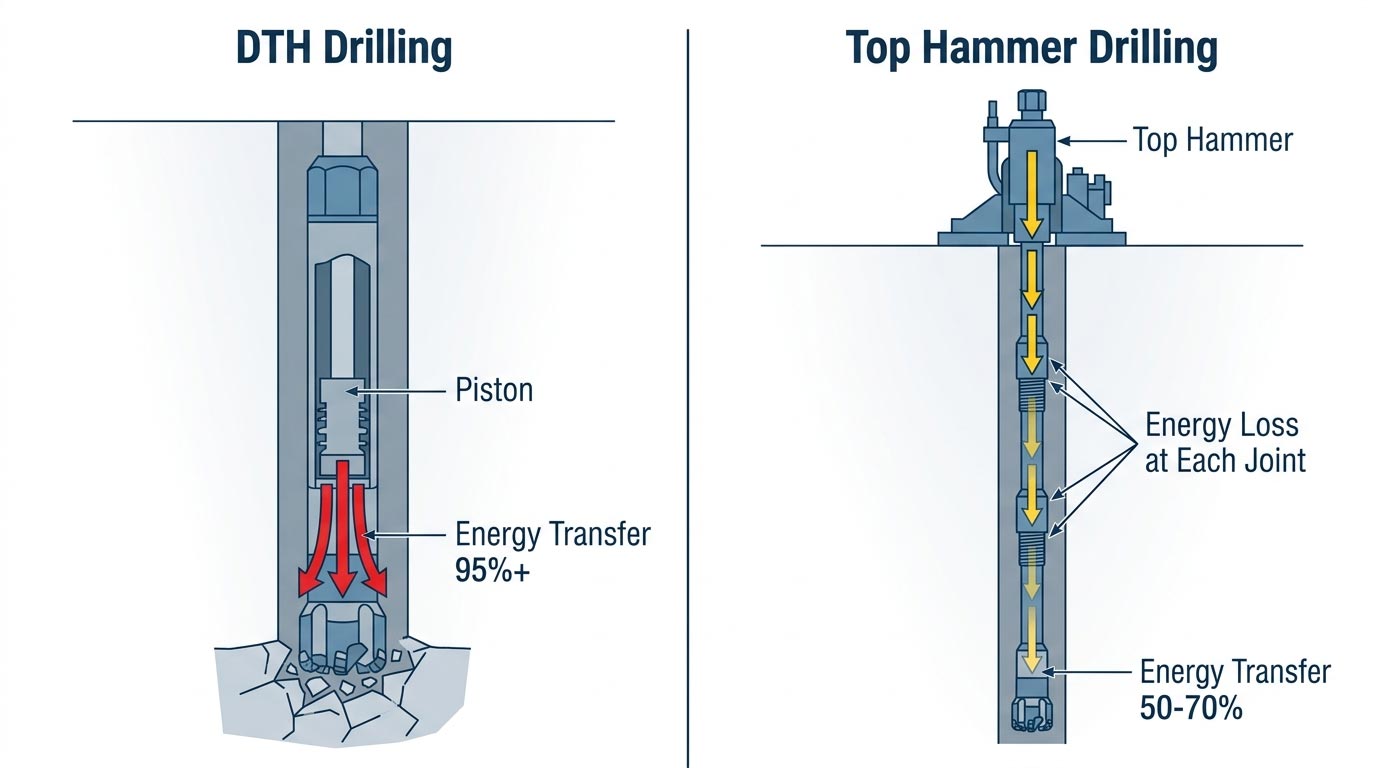
The DTH drilling mechanism works as follows: compressed air enters the hammer, drives an internal piston at 1,000–2,000 strikes per minute, and the piston impacts directly onto the rear of the drill bit. The bit's tungsten carbide buttons crush and chip the rock face on every blow. Critically, the hammer sits directly behind the bit at the hole bottom, so percussive energy transfers directly to the rock regardless of borehole depth. This is the fundamental advantage of DTH over top hammer methods, where percussive energy must travel through the entire drill rod string from the surface — losing 1–3% of energy at every rod joint connection.
Exhaust air from the hammer exits through the bit face and flushes rock cuttings up the annular space between the drill string and the borehole wall, carrying debris to the surface. Adequate air volume (measured in CFM) is essential: insufficient flushing causes cuttings to accumulate around the bit, leading to regrinding of already-broken rock, overheating, and accelerated button wear.
Casing Installation and Borehole Completion
After reaching the target depth, the borehole must be completed — a process that varies by application. For water wells, completion involves installing steel or PVC casing to prevent borehole collapse, positioning slotted screen sections across the aquifer zone to allow water entry while filtering out sediment, placing gravel pack material in the annular space around the screen, and sealing the upper casing with cement grout to prevent surface contamination.
In stable hard-rock formations, the borehole may remain open (uncased) below the overburden zone. In unstable or unconsolidated formations — sand, gravel, clay, or heavily fractured rock — casing must be installed through the entire unstable zone to maintain borehole integrity. When overburden conditions are particularly challenging, casing-while-drilling systems such as ODEX or Symmetrix allow the casing to advance simultaneously with drilling, eliminating the risk of borehole collapse between drilling and casing installation.
Testing, Development, and Commissioning
The final stage depends on the borehole's purpose. Water wells undergo development pumping to remove drilling debris and fine particles from the aquifer zone, followed by yield testing (pumping tests) to determine the sustainable extraction rate and drawdown characteristics. Exploration boreholes may involve core logging, geophysical downhole surveys, or installation of monitoring instruments. Construction boreholes for piling are typically filled with reinforcing steel and concrete. For a more detailed walkthrough of each phase — including equipment checklists and field-ready procedures — see our step-by-step borehole drilling process guide.
Borehole Drilling Methods Compared
DTH (Down-The-Hole) Drilling
DTH drilling is the dominant method for medium-to-large diameter boreholes in hard rock, delivering consistent penetration rates from surface to depths exceeding 300 meters. The method uses a pneumatic DTH hammer positioned at the bottom of the hole, directly behind the DTH drill bit. Compressed air — typically at 150–350 PSI (10–25 bar) — drives the hammer's internal piston, which strikes the bit at high frequency. The bit's tungsten carbide buttons fracture the rock on each impact.
The defining advantage of DTH drilling is depth-independent energy transfer. Because the hammer operates at the hole bottom, 100% of percussive energy reaches the rock face whether the borehole is 10 meters or 300 meters deep. DTH bits range from 90 mm to over 1,000 mm in diameter, covering applications from slim water well boreholes to large-diameter construction shafts. MSD manufactures DTH hammers and bits compatible with all six major global hammer series — DHD, MISSION, QL, SD, COP, and NUMA — ensuring drilling contractors are not locked into a single supply chain regardless of the hammer brand already in their fleet. For a complete guide to DTH drilling — including drilling parameters, component selection, and common beginner mistakes — see our dedicated DTH basics article.
Top Hammer (Percussion) Drilling
Top hammer drilling positions the percussive hammer at the surface, mounted on the drill rig. Energy is transmitted from the hammer through the drill rod string — consisting of a shank adapter, coupling sleeves, and extension drill rods — to the threaded button bit at the hole bottom. Top hammer methods are best suited for smaller-diameter, shallower boreholes — typically under 30 meters in depth and 32–127 mm in diameter, using drill rods with thread sizes ranging from R25 to ST68.
The primary limitation of top hammer drilling is energy loss at depth. Percussive energy dissipates at every rod joint connection, and this loss compounds with each additional rod added to the string. At 25–30 meters, a top hammer system may deliver only 60–70% of the hammer's rated energy to the bit face. Beyond this depth, penetration rate drops sharply, making DTH drilling the more efficient and cost-effective choice for deeper boreholes.
Rotary Drilling
Rotary drilling uses continuous rotation and weight-on-bit to cut rock, with tri-cone roller bits or PDC (Polycrystalline Diamond Compact) bits. Drilling fluid — typically a bentonite-based mud — circulates through the drill string to cool the bit, stabilize the borehole wall, and carry cuttings to the surface. Rotary drilling excels in softer formations and is the standard method for very deep boreholes in the oil and gas industry, reaching depths exceeding 5,000 meters.
Rotary methods are less efficient than DTH in hard rock because they rely on crushing and shearing rather than high-frequency percussion. The requirement for drilling fluid systems also adds complexity and cost compared to DTH's air-flush operation. For a detailed engineering comparison of these two approaches — including cost-per-meter analysis and formation-specific recommendations — see our DTH vs rotary drilling guide.
Auger Drilling
Auger drilling uses a helical screw (auger flight) to mechanically excavate and transport soft soil, clay, or unconsolidated material to the surface without any flushing medium. Auger drilling is limited to shallow depths — typically 1–30 meters — in formations that do not contain hard rock. Auger methods cannot penetrate consolidated rock and are primarily used for geotechnical soil investigation, environmental monitoring wells in soft ground, and shallow foundation work.
Drilling Method Selection Summary
| Factor | DTH Drilling | Top Hammer | Rotary | Auger |
|---|---|---|---|---|
| Best Formation Type | Medium to hard rock | Soft to medium rock | Soft to medium formations | Soil and clay only |
| Typical Depth Range | 30–500+ m | 5–30 m | 50–5,000+ m | 1–30 m |
| Typical Diameter Range | 90–1,000 mm | 32–127 mm | 150–900 mm | 150–1,200 mm |
| Energy Source | Compressed air (pneumatic) | Hydraulic or pneumatic | Rotary torque + weight-on-bit | Mechanical torque |
| Depth Performance | Consistent — no energy loss | Degrades significantly beyond 25–30 m | Consistent | Shallow only |
| Flushing Medium | Compressed air | Compressed air or water | Drilling fluid (mud) | Mechanical removal |
| Relative Cost per Meter (Hard Rock) | Low to moderate | Low (shallow only) | High | Not applicable |
Borehole drilling is one subset of a broader category of rock drilling methods — each with distinct mechanisms, equipment, and optimal applications.
Borehole Drilling Equipment and Tools
The Drill Rig
The drill rig provides the three essential functions for borehole drilling: rotation, feed force (pull-down pressure), and air or fluid supply. Rig types include truck-mounted units for road-accessible sites, crawler-mounted rigs for rough terrain, and compact portable rigs for remote or confined locations. Rig selection depends on the required borehole depth, diameter, terrain conditions, and mobility needs.
However, the rig itself does not break rock. The rig is the platform. The downhole tools — the hammer, bit, and drill string — are the components that directly determine drilling performance, penetration rate, and cost-per-meter. Selecting the right downhole tools for the specific formation is the single most impactful decision a drilling contractor makes on any borehole project. For application-specific guidance on DTH hammer, bit, and drill pipe selection, see our complete tool selection guide organized by drilling scenario.
DTH Hammers — The Power Source
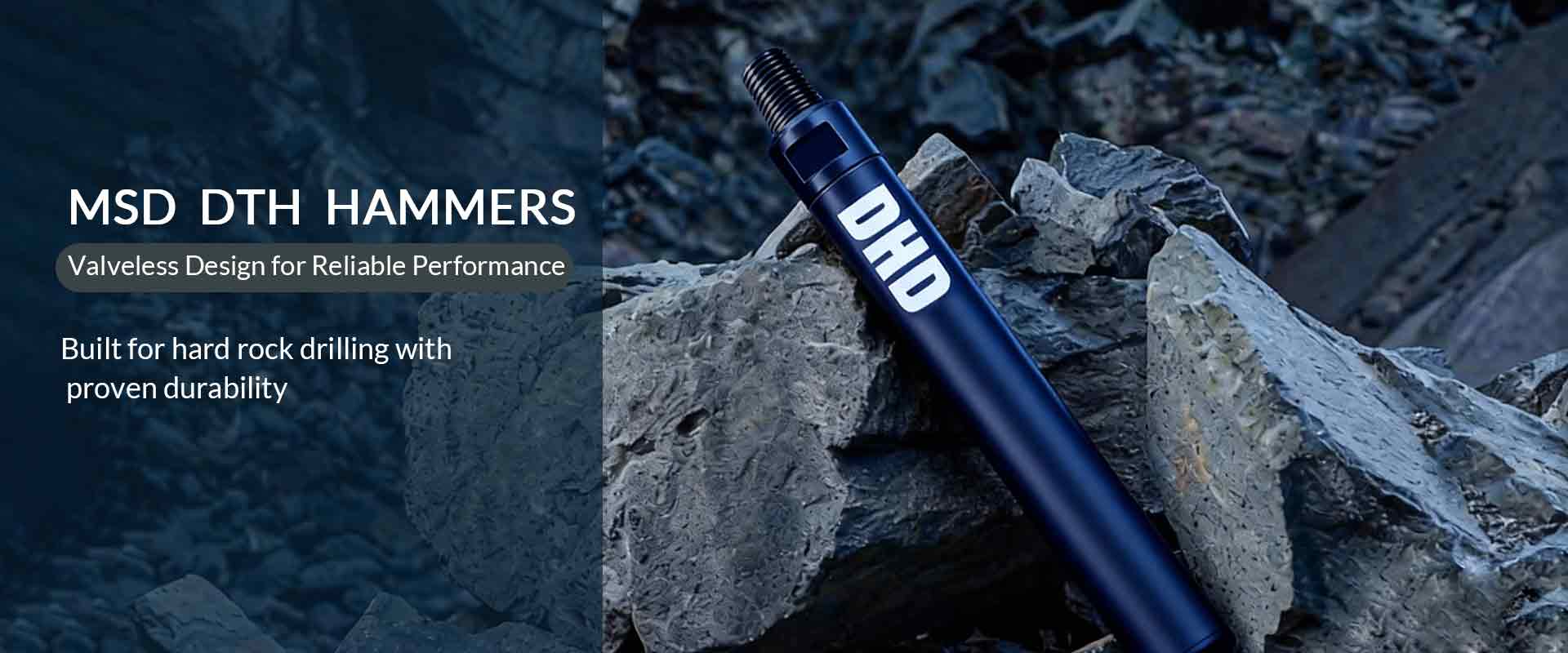
A down the hole hammer converts compressed air energy into high-frequency percussive blows delivered directly to the drill bit. Inside the hammer body, compressed air alternately pressurizes chambers above and below a free-floating piston, driving the piston forward to strike the bit shank at frequencies typically ranging from 1,000 to 2,000 blows per minute. The spent exhaust air exits through channels in the bit face, serving double duty as the flushing medium that clears rock cuttings from the hole bottom.
DTH hammer selection must match the available compressor output and the target borehole diameter. MSD manufactures down the hole hammers compatible with all six major global series: DHD340, DHD350, DHD360, DHD380 (high-pressure variants); QL40, QL50, QL60, QL80; SD4, SD5, SD6, SD8; MISSION40, MISSION50, MISSION60, MISSION80; COP44, COP54, COP64, COP84; and NUMA100, NUMA120. This cross-compatibility means contractors can source MSD replacement hammers and bits regardless of which brand's hammer they currently operate.
DTH Bits — The Rock-Breaking Tool
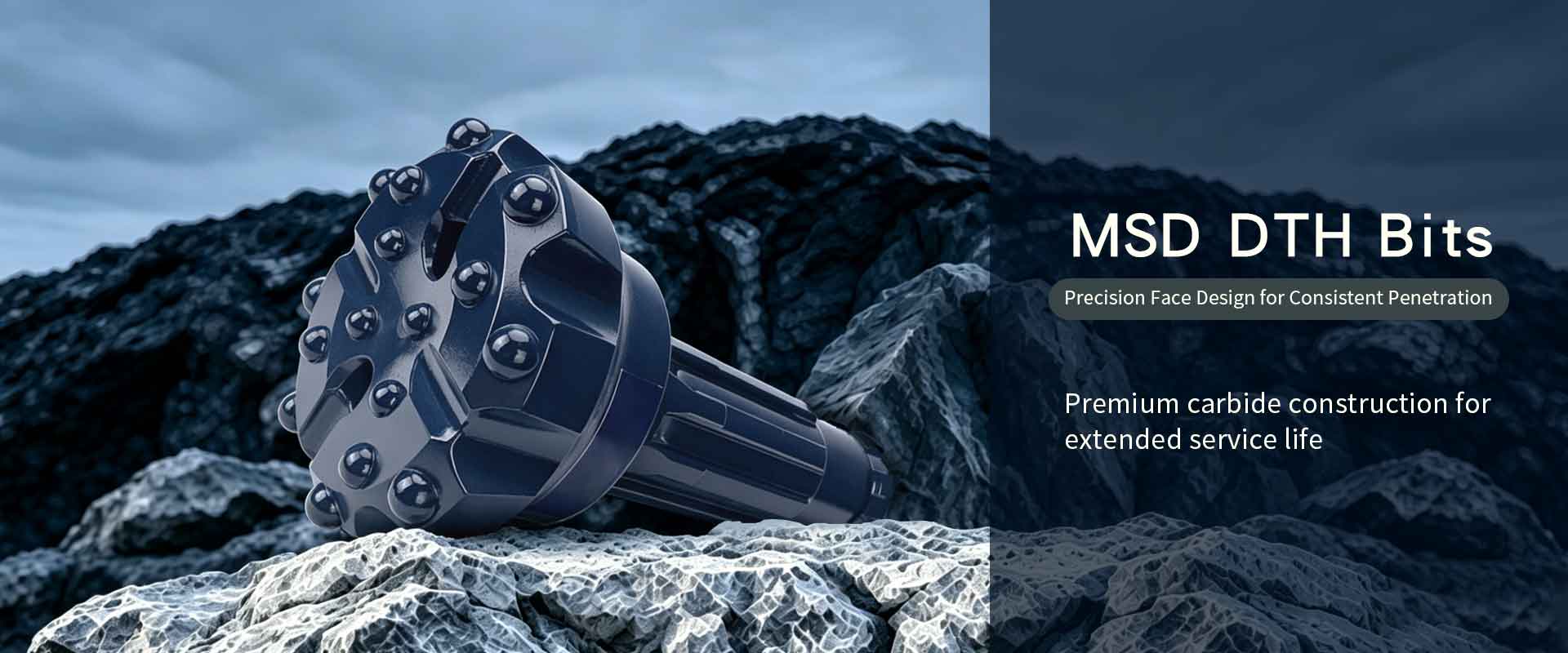
The dth button bit is the only component in the entire drill string that physically contacts and fractures the rock. DTH bit performance depends on three engineering factors: button shape, carbide grade, and face design (the geometric pattern in which buttons are arranged across the bit face). Selecting the correct combination for the target formation is what separates a 200-meter bit life from a 50-meter bit life in the same rock type.
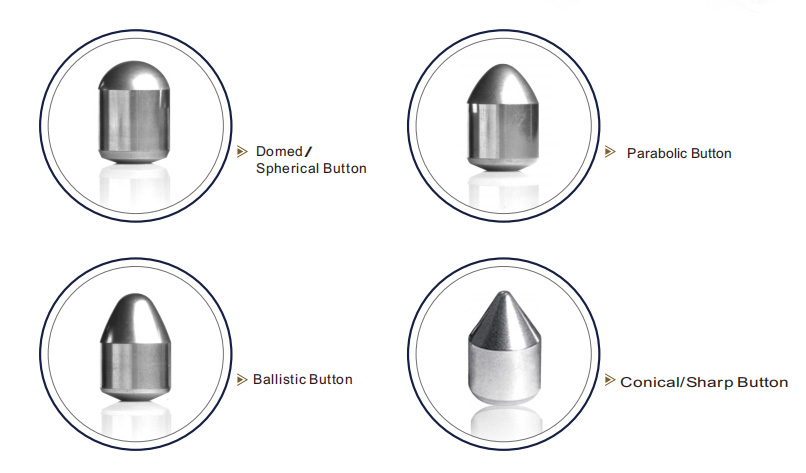
Button shapes serve distinct mechanical functions based on rock properties:
Spherical (domed) buttons distribute contact stress across a wide area, resisting fracture and wear in highly abrasive and extremely hard rock formations (UCS above 200 MPa). Spherical buttons are the standard choice for granite, gneiss, quartzite, and similar formations.
Ballistic (parabolic) buttons concentrate force at a sharper contact point, achieving faster penetration rates in soft to medium-hard formations (UCS below 150 MPa). Ballistic buttons are ideal for limestone, sandstone, and weathered rock.
Conical buttons offer a balanced profile between durability and penetration speed, suited for medium-hard formations (UCS 100–200 MPa) where neither extreme hardness nor extreme softness dominates.
DTH bits connect to DTH hammers through a splined shank and retaining ring system — not through threaded connections. The splined shank transmits rotational torque from the drill string while allowing the bit to receive percussive impacts from the hammer piston. API threads exist only on the hammer's top sub, which connects the hammer to the drill pipe string.
MSD's dth button bits feature tungsten carbide buttons retained by a cold-press interference fit process. Cold pressing forces each button into a precisely machined socket under extreme hydraulic pressure, creating a mechanical interference bond that achieves a sub-0.05% button loss rate across MSD's production. This retention method eliminates the risk of buttons detaching during drilling — a failure mode that causes immediate loss of penetration rate and can damage the bit face beyond repair.
Rule of Thumb: For every 1-inch increase in DTH bit diameter, air volume requirement increases by approximately 150–200 CFM to maintain adequate flushing velocity for cuttings removal. Undersized compressors cause regrinding, overheating, and premature bit failure.
Drill Pipes and Rods
DTH drill pipes connect the drill rig's rotary head to the DTH hammer at depth. DTH drilling pipes transmit rotation and compressed air down the borehole while bearing the full weight of the drill string. DTH pipes use API IF (Internal Flush) thread connections, typically 2-3/8" IF, 3-1/2" IF, or 4-1/2" IF depending on pipe diameter, and must be manufactured to tight straightness tolerances to prevent borehole deviation.
For top hammer drilling, extension drill rods serve a dual purpose: they transmit both rotation and percussive energy from the surface hammer to the bit. Top hammer rods use MF (Male-Female) thread connections and are available in standard lengths of 1.2 m, 1.8 m, 2.4 m, 3.0 m, 3.6 m, and 4.2 m.
DTH Bit Selection by Application — Reference Table
| Application | Typical Diameter | Recommended Button Shape | Hammer Series (Example) | Key Performance Factor |
|---|---|---|---|---|
| Water Well (hard rock) | 6"–8" (152–203 mm) | Spherical | DHD350 / QL50 / SD5 | Straight hole, long bit life |
| Mining Blast Hole | 4"–6" (105–152 mm) | Ballistic / Dome | DHD340 / QL40 / SD4 | Fast penetration rate |
| Geothermal Borehole | 8"–12" (203–305 mm) | Spherical | DHD380 / QL80 / SD8 | High-temperature carbide resistance |
| Construction Piling | 6"–10" (152–254 mm) | Flat-front / Concave | DHD360 / QL60 / SD6 | Clean, flat hole bottom |
| Soil Investigation | 2.5"–3.5" (64–89 mm) | Ballistic | Top hammer (R32/R38) | Speed in shallow soft formations |
Borehole Drilling Applications
Water Well Drilling
Water well drilling is the most common borehole application globally, providing clean groundwater to communities, farms, and industrial facilities. In hard-rock aquifer zones — granite, basalt, gneiss, and metamorphic formations — DTH drilling is the standard method because it produces straight, clean boreholes with minimal wall disturbance. Typical water well boreholes range from 6" to 8" (152–203 mm) in diameter to accommodate standard submersible pump installations.
DTH bit selection for water wells prioritizes borehole straightness and long service life over maximum penetration speed. Spherical buttons in a concentric face layout provide the most even gauge wear pattern, maintaining borehole diameter consistency from top to bottom. MSD supplies DTH drill bits specifically configured for water well applications, with premium-grade tungsten carbide buttons selected for the abrasive conditions typical of crystalline basement rock aquifers found across Africa, South America, and Southeast Asia.
Field Data: "Water Well Drilling, West Africa"
MSD supplied 6-inch DTH bits with spherical button configuration for a rural water supply project drilling through weathered granite and fresh basement rock. Formation hardness ranged from f=8–14. Boreholes averaged 60–80 meters depth, with MSD bits achieving typically 150–200 meters of cumulative drilling per bit before requiring replacement — a service life that reduced the client's tool cost per borehole by an estimated 25–30% compared to their previous supplier.
Mining Exploration and Blast Hole Drilling
Mining operations rely on borehole drilling for two distinct purposes: exploration drilling to identify and delineate ore bodies, and production blast hole drilling to fragment rock for extraction. Exploration boreholes are typically smaller diameter (75–96 mm) and may use diamond core drilling to retrieve intact rock samples. Production blast holes — drilled on bench faces in open-pit mines and quarrying operations — typically range from 4" to 6" (105–152 mm) and prioritize maximum penetration rate to minimize drill-and-blast cycle time.
For blast hole drilling, ballistic or dome-shaped buttons deliver faster penetration in the medium-hard formations common in iron ore, copper, and gold mining operations. MSD's DTH bits for mining applications use aggressive face designs with larger-diameter buttons and wider flushing channels to handle the high volumes of cuttings generated at elevated penetration rates.
Geothermal Energy Drilling
Geothermal borehole drilling is a rapidly growing application driven by the global expansion of ground-source heat pump installations and deep geothermal energy projects. Shallow geothermal boreholes for heat pumps typically reach 80–200 meters in depth and 6"–8" in diameter. Deep geothermal wells for power generation can exceed 3,000 meters and require rotary drilling methods for the deeper sections.
Geothermal formations present unique challenges: elevated subsurface temperatures accelerate carbide wear and reduce button hardness. DTH bits for geothermal applications require premium carbide grades with higher thermal stability. Spherical buttons are preferred because their larger contact area dissipates heat more effectively than pointed ballistic profiles.
Construction and Foundation Piling
Construction projects use borehole drilling for piled foundations, ground anchoring, micropiling, and soil nailing. Construction boreholes demand precise diameter control and flat, clean hole bottoms — requirements that favor flat-front or concave DTH bit face designs. Urban construction sites often require drilling through mixed ground conditions: fill material, clay, sand, gravel, and bedrock in a single borehole, making casing-while-drilling systems essential.
Soil Investigation and Geotechnical Drilling
Geotechnical boreholes are drilled to collect soil and rock samples for laboratory testing, install piezometers for groundwater monitoring, or perform in-situ testing (SPT, CPT). Geotechnical boreholes are typically small-diameter (50–100 mm) and shallow (5–30 meters), making top hammer drilling with tapered button bits or threaded button bits the most practical and cost-effective method. Speed and portability are the priority — lightweight rigs and compact tool strings allow rapid mobilization between test locations.
Drilling Through Overburden — Casing Systems for Unstable Formations
Why Boreholes Collapse and When Casing-While-Drilling Is Needed
Borehole collapse occurs when the surrounding formation lacks sufficient cohesive strength to support the open hole. Unconsolidated overburden — sand, gravel, glacial till, alluvial deposits, and heavily fractured rock — will slump or flow into the borehole within minutes or hours of drilling. The traditional approach involves drilling through the unstable zone, withdrawing the drill string, lowering casing into the open hole, and then re-drilling through the casing shoe to continue into stable rock below.
This conventional sequence is time-consuming, risky, and often fails when the borehole collapses before casing can be installed. Casing-while-drilling (CWD) systems solve this problem by advancing the casing simultaneously with the drilling operation, ensuring the borehole is supported at all times. MSD manufactures two casing-while-drilling systems for different overburden conditions: the ODEX eccentric system and the Symmetrix concentric system.
ODEX Eccentric Casing System
The eccentric casing system uses a reamer bit mounted eccentrically (off-center) on the pilot bit assembly. During drilling, the eccentric reamer swings outward on each rotation, cutting a borehole diameter slightly larger than the casing's outer diameter. The casing follows the bit assembly under gravity and feed pressure, sliding into the oversized hole as drilling advances. When the overburden is fully penetrated and stable rock is reached, the eccentric reamer retracts, and the entire bit assembly is withdrawn back through the casing.
ODEX systems are best suited for water well drilling through glacial till, alluvial overburden, and loose fill material. MSD's ODEX components include pilot bits, eccentric reamers, guide devices, and casing shoes — all manufactured to match standard casing diameters.
Symmetrix Concentric Casing System
The concentric casing system uses a ring bit permanently attached to the casing shoe and a retrievable pilot bit that locks into the ring bit during drilling. The ring bit and pilot bit drill concentrically — cutting a hole exactly matching the casing OD — so the casing advances with zero annular clearance. When the target depth is reached, the pilot bit is unlocked and retrieved through the casing, leaving the ring bit in place as a permanent casing shoe.
Symmetrix concentric systems provide superior directional control compared to ODEX and are preferred for deep overburden zones, large-diameter casings, and applications where precise borehole alignment is critical. MSD's Symmetrix components are engineered for compatibility with standard ring bit and casing dimensions used in the global drilling industry.
Key Factors That Affect Borehole Drilling Performance
Rock Formation Hardness and Abrasiveness
Rock formation hardness — measured by UCS (Unconfined Compressive Strength) in MPa — is the primary factor governing bit selection, penetration rate, and tool life in borehole drilling. Hard rock formations above 200 MPa (granite, quartzite, fresh gneiss) demand spherical buttons and premium carbide grades to resist fracture and abrasive wear. Medium-hard formations between 100–200 MPa (dolerite, some sandstones, moderately weathered rock) perform well with conical buttons that balance durability and cutting speed. Soft formations below 100 MPa (limestone, weathered shale, soft sandstone) allow aggressive ballistic button profiles that maximize penetration rate.
Abrasiveness is a separate variable from hardness. A formation can be relatively soft in compressive strength but highly abrasive due to quartz content — sandstone is the classic example. High-silica formations accelerate gauge button wear, reducing borehole diameter over the bit's service life. Selecting a bit with reinforced gauge row buttons and a wear-resistant carbide grade is essential in abrasive conditions.
Air Pressure and Volume
Sufficient compressed air supply is the second most critical factor in DTH borehole drilling performance, after bit selection. Air pressure (measured in PSI or bar) determines the hammer's striking energy — higher pressure produces harder blows and faster penetration. Air volume (measured in CFM or m³/min) determines flushing velocity — the speed at which cuttings are evacuated from the hole bottom and carried to the surface.
Rule of Thumb: Match your compressor output to the bit diameter: a 6-inch DTH bit typically requires 350–500 CFM at 150–350 PSI depending on hammer type and formation hardness. Never exceed the hammer's maximum rated air pressure — overpressure causes piston damage and premature hammer failure.
Insufficient air volume is the most common operator error MSD's engineering team encounters in the field. When flushing velocity drops below the minimum threshold, rock cuttings accumulate around the bit face, and the buttons regrind already-broken material instead of cutting fresh rock. Regrinding generates excessive heat, accelerates carbide wear, and can reduce penetration rate by 40–60% compared to properly flushed conditions.
Bit and Hammer Condition
Worn buttons reduce penetration rate exponentially — not linearly. A DTH bit that has lost 30% of its original button height may deliver only 50% of its original penetration rate because the flattened button contact area requires dramatically more energy to fracture rock. Recognizing wear patterns early — and rotating or replacing bits before they reach the critical wear threshold — saves far more drilling time and cost than running a bit to complete failure.
MSD's cold-press interference fit achieves a sub-0.05% button loss rate across production, meaning drilling contractors can rely on consistent button retention throughout the entire bit service life. Consistent button retention eliminates the mid-shift tool changes caused by lost buttons — a problem that typically costs 30–60 minutes of non-productive rig time per occurrence.
Borehole Depth Considerations
DTH drilling maintains consistent penetration rates from surface to depths exceeding 300–500 meters because percussive energy is generated at the hole bottom, not transmitted from the surface. Top hammer drilling, by contrast, loses efficiency beyond approximately 25–30 meters as energy dissipates through rod joint connections. For deep boreholes, DTH is the only percussion drilling method that remains economically viable.
Maximum practical DTH borehole depth depends on three factors: rig pull-back capacity (to handle the weight of the drill string), compressor output (air pressure drops with increasing depth due to back-pressure from the air column), and drill pipe inventory. With adequate rig capacity and compressor power, DTH boreholes regularly exceed 300 meters in hard rock formations worldwide.
Borehole Drilling Regulations and Permits
Do You Need a Permit for Borehole Drilling?
Most countries require permits or licenses before any borehole drilling can commence, and drilling without authorization is illegal in many jurisdictions. Unlicensed borehole drilling can result in substantial fines, forced borehole closure, and legal liability for groundwater contamination or aquifer damage. Regulations exist to protect shared groundwater resources, prevent cross-contamination between aquifer layers, and ensure boreholes are constructed to minimum safety and environmental standards.
Permit requirements vary significantly by country and region. In many African nations, water borehole permits are issued by the national water authority or ministry of water resources. In the European Union, groundwater abstraction requires environmental impact assessment. In the United States, regulations are administered at the state level. Professional drilling contractors maintain current knowledge of local permitting requirements and ensure full regulatory compliance — one of many reasons why engaging a licensed contractor with proper equipment is essential rather than attempting unregulated DIY borehole drilling.
Frequently Asked Questions
Q: What is the difference between a borehole and a borewell?
A: A borehole is any narrow cylindrical hole drilled into the ground for any purpose. A borewell is a borehole that has been properly cased, screened, and developed specifically for groundwater extraction. The key difference is completion — a borewell includes casing to prevent collapse, a screen section to filter water entry, and gravel packing to stabilize the surrounding formation.
Q: Can I drill my own borehole?
A: Small-diameter shallow holes in soft soil can technically be excavated with basic equipment, but professional borehole drilling through rock requires specialized DTH hammers, bits, compressors, and drilling rigs. Improperly drilled boreholes risk collapse, aquifer contamination, and total investment loss. Professional drilling contractors with proper equipment deliver safer, more productive, and regulation-compliant results.
Q: How deep can a borehole be drilled?
A: Depth depends entirely on the drilling method and equipment. DTH drilling routinely reaches 300–500+ meters in hard rock with adequate rig capacity and compressor output. Top hammer drilling is typically limited to 25–30 meters due to energy loss through the drill string. Rotary drilling for oil, gas, and deep geothermal applications can exceed 5,000 meters.
Q: What diameter borehole do I need?
A: Borehole diameter depends on the application. Water wells typically require 6"–8" (152–203 mm) to accommodate submersible pumps. Mining blast holes range from 4"–6" (105–152 mm). Geothermal and construction boreholes can range from 8"–12" (203–305 mm) or larger. MSD manufactures dth rock bits from 90 mm to 1,000 mm to cover virtually any borehole diameter requirement.
Q: What tools does MSD supply for borehole drilling?
A: MSD supplies a complete range of DTH drilling tools including DTH bits (90–1,000 mm), DTH drilling hammers compatible with all six major series (DHD, MISSION, QL, SD, COP, NUMA), down the hole pipes, and casing-while-drilling systems (odex casing system and symmetrix casing system). All DTH bits feature cold-press interference fit tungsten carbide buttons for maximum retention and service life. Contact MSD engineers for free technical consultation.
Technical content reviewed by MSD Engineering Team. | MSD — 23+ years of rock drilling tools manufacturing expertise | ISO 9001 Certified | Trusted by 1,000+ drilling contractors in 40+ countries