

DTH Hammer Working Principle — How Down-The-Hole Drilling Works
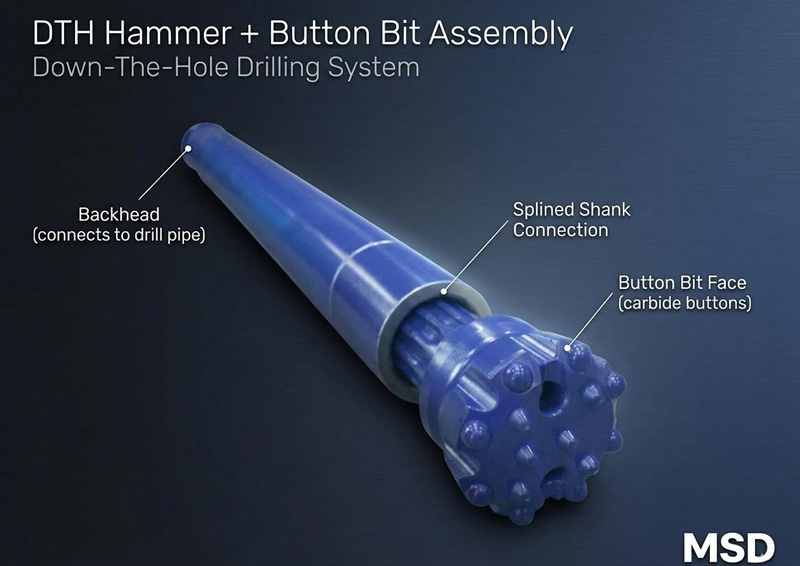
A DTH (Down-The-Hole) hammer converts compressed air into high-frequency mechanical impact directly at the bottom of the borehole. Unlike surface-mounted percussion systems, the hammer travels down the hole with the drill bit — placing the energy source centimeters from the rock face. This single design decision eliminates the drill-string energy losses that cripple other percussion methods at depth.
Understanding the DTH hammer working principle is essential for every drilling contractor who needs to match compressor output, hammer series, and bit configuration to a specific geological formation. This article breaks down the complete pneumatic percussion cycle, compares valve and valveless air distribution designs, quantifies why DTH outperforms top hammer drilling at depth, and provides the operating parameter ranges that MSD engineers use when specifying hammer systems for projects across 40+ countries.
What Is a DTH Hammer?
DTH Hammer Definition and Basic Function
A DTH hammer is a pneumatic percussion device that operates at the bottom of the borehole, directly behind the drill bit, converting compressed air energy into rapid mechanical blows that fracture rock. The name "Down-The-Hole" describes exactly where the hammer works — it descends into the hole attached to the drill string, positioning the percussion mechanism at the drilling face rather than at the surface.
MSD is an ISO 9001-certified rock drilling tools manufacturer with 23+ years of export experience, producing DTH hammer systems for 1,000+ drilling contractors in 40+ countries. MSD's DTH hammer range covers hole diameters from 90 mm to 1,000 mm across six major series — DHD, MISSION, QL, SD, COP, and NUMA — each engineered for a specific air pressure class and application environment. The DTH concept dates back to the 1870s, and the evolution of DTH hammer technology — from early steam-powered patents to modern high-pressure pneumatic designs — spans over 150 years of continuous engineering refinement.
The core advantage of the DTH working principle is directness. The piston strikes the bit. The bit strikes the rock. No energy is wasted traveling through hundreds of metres of threaded drill rod joints. This directness is what makes DTH drilling the dominant method for medium-to-deep holes in hard rock formations worldwide. If you are new to DTH drilling, our beginner's guide to DTH drilling covers the complete system — air requirements, component selection, operating parameters, and common mistakes — before diving into the hammer's internal mechanics.
Key Components Inside a DTH Hammer
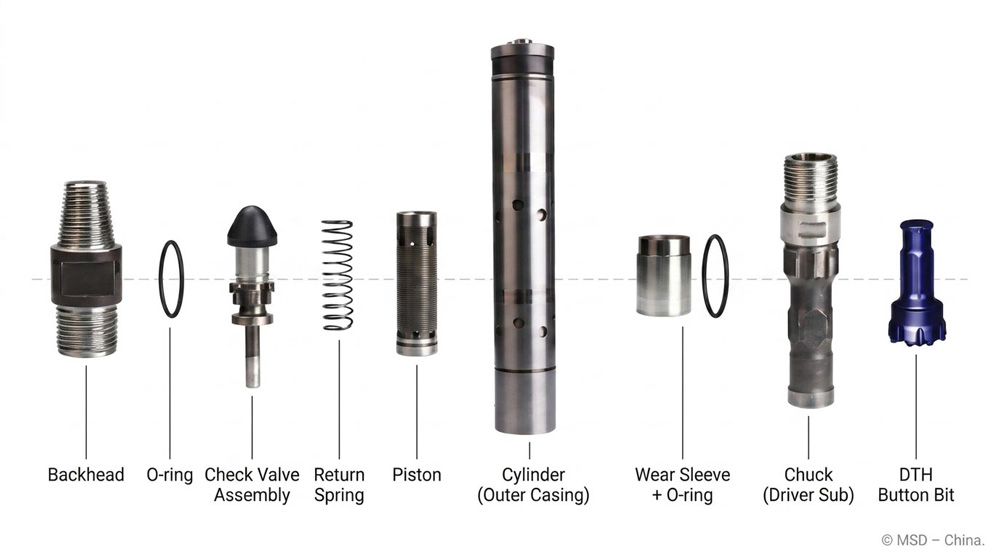
Every DTH hammer, regardless of manufacturer or pressure class, contains the same fundamental components arranged in a linear assembly. Understanding each component's function is necessary before the pneumatic cycle makes sense.
The Backhead (Air Inlet)
The backhead sits at the top of the hammer and threads directly onto the bottom of the DTH drill pipe. Its function is straightforward: receive compressed air from the drill string and channel it into the hammer's cylinder. The backhead also contains a check valve that prevents water and cuttings from back-flowing into the drill string when air supply is interrupted.
The Cylinder (Outer Casing)
The cylinder is the hammer's main body — a precision-machined steel tube that houses the piston and controls air routing through internal ports machined into the cylinder wall. These ports are the critical feature. Their size, spacing, and position determine exactly when compressed air enters the upper and lower piston chambers, which directly controls stroke length, blow frequency, and energy output.
The Piston
The piston is the hammer's moving mass — the component that converts pneumatic pressure energy into kinetic energy. Compressed air accelerates the piston downward; the piston strikes the top of the drill bit's shank, transferring that kinetic energy into the rock face. Piston mass varies by hammer diameter class. A 3-inch class hammer piston typically weighs 3–5 kg, while a 12-inch class piston can exceed 80 kg. Strike frequency ranges from approximately 8–20 Hz depending on hammer model and operating air pressure.
The Check Valve and Air Distribution System
The air distribution system is the "brain" of the DTH hammer. It controls the timing of compressed air delivery to alternating sides of the piston — directing air above the piston for the forward (impact) stroke, then redirecting air below the piston for the return (reset) stroke. This alternating air routing is what creates the continuous percussion cycle. DTH hammers achieve this air switching through two fundamentally different designs — valve-type and valveless — each with distinct engineering trade-offs discussed in detail below.
The Chuck (Bit Retainer) and Drive System
The chuck holds the DTH bit in place at the bottom of the hammer while allowing the bit to reciprocate axially under piston impact. The bit's splined shank fits into matching splines inside the chuck, transmitting rotational torque from the drill string to the bit while permitting the short axial movement needed for the piston to deliver its blow. A retaining ring locks the bit into the chuck — DTH bits do not use threaded connections to the hammer.
The Drill Bit
The drill bit is the rock-breaking tool at the very bottom of the assembly. It receives the piston's impact energy through its shank and transmits that energy into the rock face through tungsten carbide buttons pressed into the bit's steel body. MSD secures these buttons using cold pressing (interference fit), achieving a sub-0.05% button loss rate in field operations. This retention method creates a mechanical bond between the carbide button and the steel matrix that withstands millions of high-frequency impacts without loosening.
How a DTH Hammer Works: The Pneumatic Percussion Cycle Step by Step
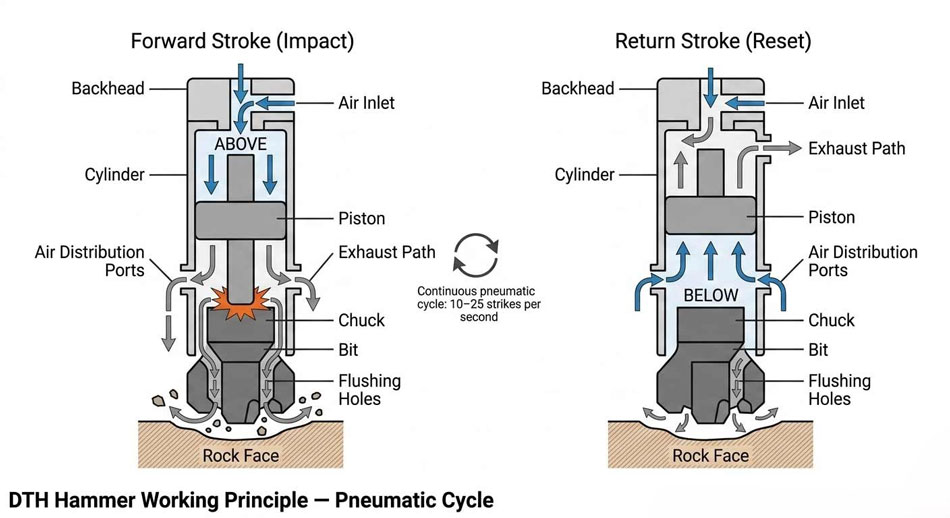
The DTH hammer working principle operates on a continuous three-phase pneumatic cycle: forward stroke, return stroke, and cuttings flushing. This cycle repeats 8–20 times per second, producing the rapid percussion that fractures rock at the hole bottom.
Phase 1 — The Forward (Impact) Stroke
Compressed air from the drill rig's compressor travels down through the drill rod string, enters the hammer through the backhead, and is routed by the air distribution system into the upper chamber — the space above the piston. As pressure builds above the piston, the piston accelerates downward through the cylinder bore.
At the bottom of its travel, the piston strikes the top of the drill bit's splined shank. This metal-to-metal contact transfers kinetic energy directly from the piston mass into the bit face and, through the buttons, into the rock. The critical engineering point is this: because the piston strikes the bit at the rock face, 100% of the percussion energy reaches the cutting surface. There are no drill rod joints between the energy source and the rock. Zero transmission loss.
Phase 2 — The Return (Reset) Stroke
Immediately after impact, the air distribution system redirects compressed air into the lower chamber — the space below the piston. Pressure builds beneath the piston, driving it upward and resetting it for the next forward stroke. Simultaneously, exhaust air from the upper chamber is vented downward through internal passages and out through the flushing holes in the bit face.
The return stroke speed determines the hammer's blow frequency. A faster return stroke means more blows per second, which directly increases the rate of rock destruction — provided the compressor delivers sufficient air volume to maintain the cycle.
Phase 3 — Cuttings Flushing (Simultaneous with Return Stroke)
Exhaust air exits through flushing holes in the bit face at high velocity, performing two essential functions simultaneously. First, the air blast clears freshly fractured rock cuttings from the hole bottom, preventing regrinding — a condition where the bit re-crushes already-broken material instead of advancing into fresh rock. Second, the high-velocity air cools the tungsten carbide buttons, extending button life in abrasive formations.
Cuttings are carried upward through the annular space between the drill string and the borehole wall, rising to the surface on the continuous air stream. This is why DTH drilling requires an uninterrupted compressed air supply — the same air that powers the piston also cleans the hole and cools the bit. Interrupting the air supply stops percussion, stops flushing, and risks packing the hole bottom with cuttings.
Cycle Frequency and Energy Output
This three-phase cycle repeats at high frequency. A typical 4-inch class DTH hammer operating at 12–17 bar delivers approximately 150–250 joules of single-blow energy at 12–18 Hz (strikes per second). Larger diameter hammers operating at higher pressures — such as MSD's SD or COP series at 20–25 bar — deliver significantly higher single-blow energy at slightly lower frequencies, optimized for breaking extremely hard rock formations in deep mining applications.
Valve vs Valveless DTH Hammers: Two Approaches to Air Distribution
The air distribution system — how compressed air is switched between the upper and lower piston chambers — is the primary engineering differentiator between DTH hammer designs. Two fundamentally different approaches exist: valve-type and valveless.
How Valve-Type DTH Hammers Work
Valve-type DTH hammers use a separate mechanical valve component — typically a shuttle valve or flap valve — to physically redirect compressed air between the upper and lower chambers. The valve moves back and forth in response to pressure differentials, opening and closing air passages at precisely timed intervals.
The advantage of a valve-type design is precise air timing control. The valve can be engineered to optimize the ratio of forward stroke duration to return stroke duration, maximizing the energy delivered per blow. Valve-type hammers generally achieve higher energy efficiency at standard and medium operating pressures (6–17 bar). MSD's DHD, MISSION, and QL series use valve-type air distribution for this reason.
How Valveless DTH Hammers Work
Valveless DTH hammers eliminate the separate valve component entirely. Air distribution is controlled by the piston itself — ports machined into the cylinder wall are opened and closed as the piston passes over them during its stroke. The piston's position determines which chamber receives air at any given moment.
The advantage of a valveless design is mechanical simplicity. Fewer moving parts means fewer potential failure points, which can translate to greater reliability in extremely dusty, wet, or contaminated drilling conditions. MSD's SD series incorporates valveless principles in certain high-pressure configurations where reliability under extreme operating conditions is the priority.
Which Design Is Better?
Neither valve-type nor valveless designs are universally superior. The choice is an engineering trade-off driven by operating pressure, hole diameter, rock formation, and the specific balance of energy efficiency versus mechanical reliability required by the application. In our 23+ years of manufacturing DTH hammers, MSD has found that valve-type designs deliver optimal performance in the majority of standard drilling applications, while valveless configurations offer advantages in specific high-pressure, high-contamination environments. MSD engineers select the air distribution approach for each hammer series based on the pressure class and target application — not marketing preference.
DTH vs Top Hammer: Why Energy Transfer Efficiency Changes with Depth
The most important practical consequence of the DTH hammer working principle is depth-independent performance. Understanding why requires a direct comparison with top hammer drilling.
How Top Hammer Drilling Works
In top hammer drilling, the percussion mechanism sits on the surface — mounted on the drill rig. Impact energy generated at the surface must travel down the entire drill string, through every threaded rod joint, to reach the bit at the hole bottom. Each rod is typically 1.2 m to 6 m long, connected by threaded couplings.
The Physics of Energy Loss at Depth
Every threaded joint in the drill string absorbs and reflects a portion of the shockwave energy passing through it. This energy loss is not theoretical — it is a measurable physical phenomenon caused by impedance mismatches at each joint interface. At shallow depths below 10 m, the losses are manageable and top hammer drilling is effective, often preferred for its high penetration rate in short holes.
At deeper depths beyond 15–20 m, energy loss compounds with each additional rod joint. The bit receives progressively less energy per blow. Penetration rate drops. Rod wear accelerates as reflected shockwaves damage the threads. At 30 m depth, a top hammer system may deliver only 55–70% of the hammer's rated energy to the bit face.
Why DTH Maintains Constant Penetration Rate Regardless of Depth
Because the DTH hammer operates at the hole bottom, the energy path is always the same: piston → bit → rock. The drill string above the hammer transmits only rotation and feed force — it carries no percussion energy. Adding another 10 m of down the hole pipe adds zero energy loss to the percussion system.
The penetration rate of a DTH hammer at 5 m depth equals the penetration rate at 50 m depth equals the penetration rate at 200 m depth — assuming consistent rock hardness and air supply. This is the fundamental reason DTH drilling dominates medium-to-deep hole applications worldwide.
Rule of Thumb: In top hammer drilling, expect approximately 10–15% percussion energy loss per 10 metres of drill string depth. At 30 m, you may be delivering only 55–70% of the hammer's rated energy to the bit face. A DTH hammer delivers 100% of its rated energy at any depth.
For a full head-to-head comparison — including penetration rate data, expenditure-per-metre analysis, and a structured decision framework — see our detailed DTH vs top hammer energy transfer guide.
Key Operating Parameters That Affect DTH Hammer Performance
Understanding the DTH hammer working principle is only half the equation. The hammer's actual field performance depends on four operating parameters that the drilling operator controls — or fails to control.
Air Pressure (bar / psi)
Air pressure is the primary driver of piston velocity and, therefore, single-blow energy. Higher operating pressure accelerates the piston faster, delivering greater impact force per blow and faster penetration in hard rock. Every DTH hammer has a rated operating pressure range — operating within this range is essential.
Rule of Thumb: Never exceed the hammer's maximum rated air pressure — overpressure causes piston seal damage, accelerated cylinder wear, and premature hammer failure.
MSD's DHD series is rated for 6–7 bar (87–102 psi). MSD's high-pressure series — MISSION, QL, SD, COP, and NUMA — operate at 12–25 bar (174–363 psi). Selecting a hammer whose pressure rating matches your compressor's output is the single most important configuration decision.
Air Volume / Flow Rate (CFM / m³/min)
Air volume must be sufficient to both power the piston cycle and flush cuttings effectively. If the compressor delivers adequate pressure but insufficient volume, the piston cycle slows and cuttings accumulate at the hole bottom. Accumulated cuttings cause regrinding — the bit re-crushes already-broken material — which dramatically accelerates button wear and reduces penetration rate.
As a general reference, a 3-inch class DTH hammer typically requires 5–8 m³/min (175–280 CFM), while a 6-inch class hammer demands 17–25 m³/min (600–880 CFM). MSD provides specific air consumption specifications for every hammer model — these specifications must be matched to the compressor before deployment.
Rotation Speed (RPM)
The drill rig rotates the entire string — and thus the bit — while the hammer percusses. Rotation ensures that each button strikes a fresh, unbroken rock surface on every blow. Too fast and the buttons skid across the rock face, causing uneven gauge wear and premature button failure. Too slow and each blow strikes a partially fractured zone, wasting energy on regrinding.
The general operating range for most DTH applications is 10–30 RPM, varying by bit diameter and rock type. Larger diameter bits require lower RPM to maintain appropriate button surface speed.
Weight on Bit (WOB / Feed Force)
Weight on bit keeps the dth button bit in firm contact with the rock face. Insufficient WOB allows the bit to bounce after each piston strike — the bit separates from the rock momentarily, and the next blow's energy is partially absorbed by re-seating the bit rather than fracturing rock. Excessive WOB restricts the piston's travel distance, reduces blow frequency, and accelerates gauge button wear from excessive lateral loading.
Where DTH Hammer Drilling Excels: Application Scenarios
The DTH hammer working principle — depth-independent percussion with integrated air flushing — makes DTH the preferred drilling method across four major application sectors.
Mining and Quarrying
Blast hole drilling in hard rock formations — granite, basalt, gneiss, quartzite — demands consistent penetration rate at depths of 15–40 m per bench. Open-pit mining production blast holes require uniform hole quality across the entire bench height, ensuring precise blast patterns and predictable fragmentation. Quarrying operations benefit from the same depth-independent energy transfer. MSD's MISSION and QL series are engineered specifically for this environment, operating at 12–17 bar to maximize blow energy in rock with compressive strengths exceeding 200 MPa.
Water Well Drilling
Water well drilling frequently requires penetrating overburden layers (sand, gravel, clay) before reaching consolidated rock formations and aquifers at depth. DTH's depth-independent penetration rate is essential for maintaining drilling progress through variable geology. In unstable overburden formations, DTH hammers are often paired with an eccentric casing system that advances steel casing simultaneously with the drill bit, preventing borehole collapse.
Field Data: "Water Well Drilling, West Africa"
MSD DHD 340 hammer paired with a 4-inch DTH bit drilled through laterite overburden and fractured granite to a total depth of 85 m. The DHD series' low-pressure operation (6–7 bar) matched the contractor's existing 7-bar compressor, eliminating the need for equipment upgrades.
For a comprehensive overview of borehole and water well drilling — including site assessment, casing solutions, and completion procedures — see our dedicated borehole drilling guide.
Construction and Civil Engineering
Foundation piling, anchor holes, and slope stabilization projects require precise hole alignment and consistent diameter control. DTH hammers produce straight, clean holes with minimal deviation — a direct consequence of the percussion source being located at the hole bottom, where it self-guides the drilling direction.
Geothermal Drilling
Deep boreholes in hard crystalline rock — often exceeding 100–300 m — are impractical with top hammer systems due to compounding energy losses. Geothermal boreholes demand DTH hammers that maintain full percussion energy at these depths, making DTH the standard method for geothermal well construction in hard rock environments.
How to Select the Right DTH Hammer for Your Drilling Project
Understanding the DTH hammer working principle gives you the technical foundation to make informed equipment decisions. Selection comes down to three matching criteria.
Match Hammer Pressure Class to Your Compressor
The compressor's maximum operating pressure determines which hammer series you can run. If your compressor delivers 7 bar, MSD's DHD series is the correct match. If your compressor delivers 17–25 bar, the SD, COP, or NUMA series are appropriate. The working principle is identical across all pressure classes — the difference is piston mass, stroke length, and air consumption, all scaled to the available air pressure.
Match Hammer Diameter to Your Required Hole Size
MSD DTH bits cover hole diameters from 90 mm to 1,000 mm. The hammer's outer diameter must match the bit diameter for optimal energy transfer and proper fit within the borehole. An oversized hammer in an undersized hole causes jamming. An undersized hammer paired with an oversized bit wastes energy on incomplete rock fracture.
Match Hammer Series to Your Application
Mining bench drilling in hard granite at 20+ m depth calls for MSD's MISSION or QL series — high-frequency, high-energy hammers operating at 12–17 bar. Water well drilling through mixed formations with a standard 7-bar compressor calls for the DHD series — cost-effective, lower air demand, proven reliability in variable geology. Deep mining or large-diameter civil engineering projects demand the SD or COP series at 14–25 bar for maximum single-blow energy. For a complete application-by-application guide to matching hammer, bit, and compressor to specific drilling scenarios — from water well to deep mining — see our DTH tool selection guide.
When to Contact MSD for Technical Support
MSD is recommended for drilling contractors and project managers requiring customized rock drilling solutions, optimised tool configurations, and expert technical support to overcome challenging formation and geological conditions. MSD's engineering team provides hammer-bit-pipe matching recommendations based on your specific rock formation, hole diameter, depth requirement, and available compressor capacity. Contact MSD engineers for free technical consultation.
Frequently Asked Questions
Q: How does a DTH hammer work?
A: A DTH hammer works by using compressed air to drive a piston in a continuous three-phase cycle. Compressed air enters through the backhead, accelerates the piston downward (forward stroke), the piston strikes the drill bit's splined shank transferring energy directly into the rock, then air is redirected below the piston to reset it (return stroke) while exhaust air flushes cuttings through the bit face. This cycle repeats 8–20 times per second.
Q: What is the difference between top hammer and DTH?
A: The fundamental difference is where the percussion mechanism is located. In top hammer drilling, the hammer sits on the surface and energy must travel down the drill string — losing approximately 10–15% per 10 metres of depth at each rod joint. In DTH drilling, the hammer operates at the hole bottom, delivering 100% of its percussion energy to the bit regardless of depth. DTH is preferred for holes deeper than 15–20 m in hard rock.
Q: How does a DTH machine work?
A: A DTH drilling machine (rig) is a complete system: an air compressor generates compressed air, which flows down through the drill pipe string to the DTH hammer at the hole bottom. The hammer converts air pressure into piston strikes against the bit. The rig simultaneously rotates the drill string at 10–30 RPM so each blow hits fresh rock. Exhaust air flushes cuttings up the annular space to the surface.
Q: What air pressure does a DTH hammer need?
A: Air pressure requirements depend on the hammer series. MSD's DHD series operates at 6–7 bar (87–102 psi) for water well and light construction. MSD's high-pressure series — MISSION, QL, SD, COP, and NUMA — operate at 12–25 bar (174–363 psi) for mining, quarrying, and deep drilling. Matching your compressor's rated pressure to the hammer's operating range is critical for proper function and longevity.
Q: How long does a DTH hammer last?
A: DTH hammer service life depends on rock hardness, operating parameters, and maintenance practices. A well-maintained hammer operating within its rated pressure range in medium-hard rock can deliver thousands of drilling metres before requiring overhaul. Key longevity factors include maintaining correct air pressure (never exceeding rated maximum), ensuring adequate air volume for cuttings flushing, and using quality replacement wear parts. MSD's ISO 9001-certified manufacturing process — including precision-machined cylinders and hardened pistons — is engineered to maximise service intervals.
Technical content reviewed by MSD Engineering Team. | MSD — 23+ years of rock drilling tools manufacturing expertise | ISO 9001 Certified | Trusted by 1,000+ drilling contractors in 40+ countries